

Short answer: AI customer review analysis works best when the AI extracts each complaint and piece of praise in the reviewer’s own words, then counts how many distinct reviewers raise each theme, for your reviews and your competitors’. Keep the AI on extraction and counting. Leave the verdicts, such as what counts as negative and what to fix, to a person who has read the quotes.
Most guides lead with a sentiment score: a share marked positive and an arrow showing the trend. That score is the least useful thing in your reviews. The value is in the words, and in how your words compare with a rival’s.
Why a sentiment score is the wrong output
A sentiment label is a verdict, and AI verdicts go wrong in ways that are hard to see. A four-star review that says “great product, but support took nine days” is positive by the stars and a warning by the text. Sarcasm and mixed reviews make it worse.
We learned this on account notes, not reviews. On our CS team, a daily scan turned client chat threads into notes with a one-word risk label, and it marked a high-touch account “Healthy” because the thread was about setting up a weekly sync. The real signal ran the other way: declined meetings, and a CSM working hard to force any cadence at all. We added a calibration rule, then removed the labels entirely; the notes are now facts only, each dated “as of” the day it was read.
Reviews deserve the same treatment. Ask the AI for facts: what the reviewer praised or complained about, their exact words, the rating, the date. Facts are safe to automate. The verdict waits for a person.
Where to find reviews, yours and your competitors’
Every review source over-represents someone, so collect from two or three and note which each quote came from.
Source | Good for | Watch out for |
|---|---|---|
G2, Capterra, TrustRadius | B2B software: setup, support, switching stories | Reviews prompted by vendor campaigns; old product versions |
Amazon, Trustpilot, your store’s reviews | Consumer products: quality, delivery, value | Incentivized and fake reviews; reviews of the seller, not the product |
App Store, Google Play | Apps: bugs, pricing changes, specific releases | Spikes after one bad update that skew the whole year |
Reddit, forums, social posts | Unprompted opinions and comparisons | Few posts per brand; one loud thread can dominate |
Your support tickets and survey comments | Your own customers, including the ones who never post publicly | No competitor equivalent |
Platform rules explain some of that skew. G2 lets vendors invite and reward reviewers, as long as the reward doesn’t depend on the opinion, and it labels those reviews as incentivized. In the US, a 2024 FTC rule bans fake reviews and reviews bought to push a particular sentiment. On the App Store, a developer can reset the star rating with a new version while the written reviews stay up, so filter by date before you count.
Social listening with AI is the same method pointed at posts and comments instead of review sites. It is noisier, so it works better as a check on themes you found in reviews than as the first source.
How to do AI customer review analysis, step by step
The method has five steps, and the one most guides skip is the third: approving the theme list before anything is counted. The diagram below shows the order.
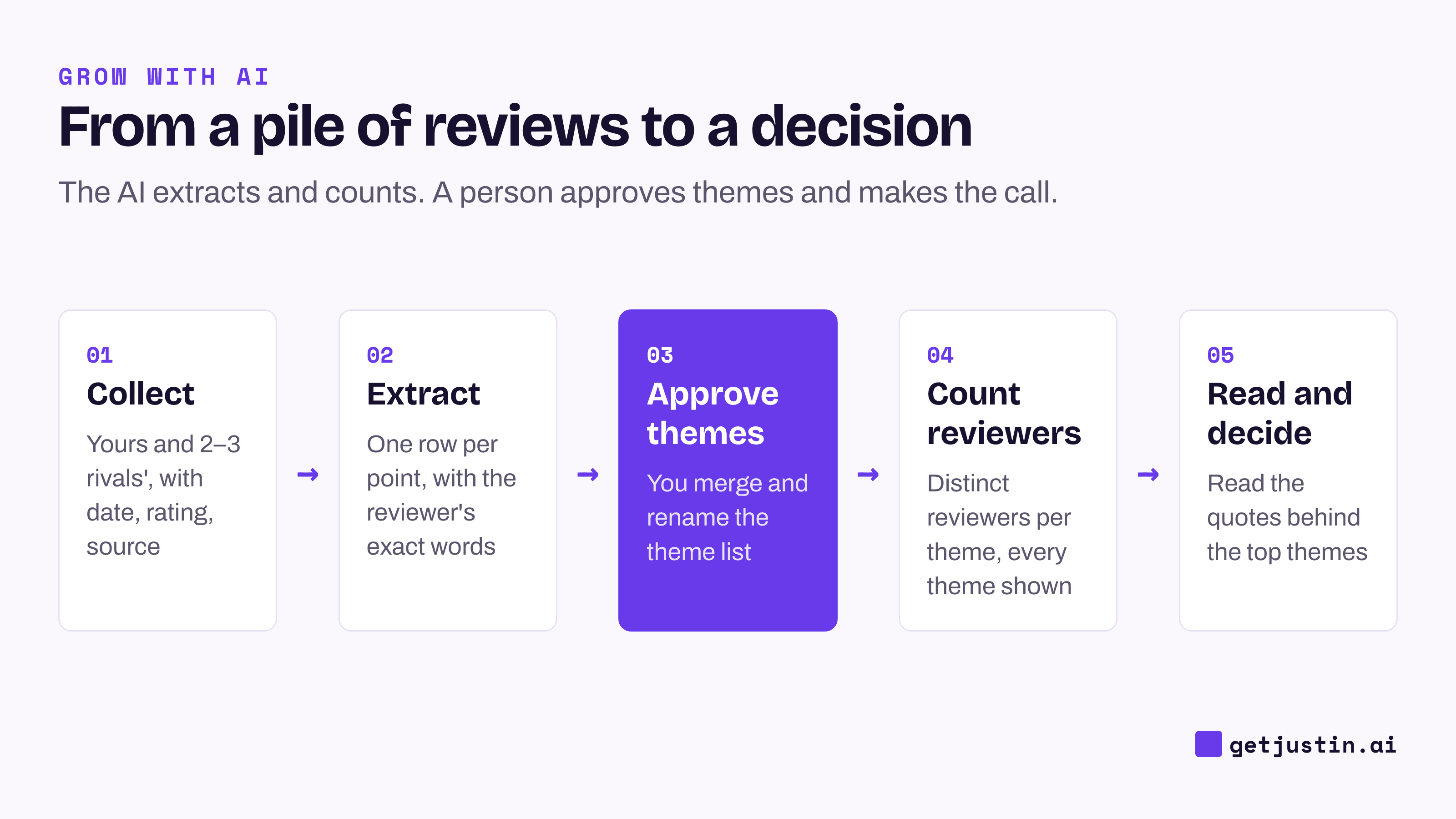
Figure: The AI extracts and counts; a person approves the themes and makes the call.
Collect. Export your own reviews where each platform’s business dashboard allows it, and gather 100 to 300 recent reviews per competitor, with date, rating and source on every row.
Extract. Ask for one row per point, not per review, since a single review often praises one thing and complains about another. Use the table below.
Approve themes. Have the AI propose 10 to 20 theme names, then merge and rename them yourself. “Onboarding” and “setup took weeks” might be one theme or two, and only you know which.
Count reviewers. Count distinct reviewers per theme, not mentions; one angry reviewer posting five times is one complaint. The competitor research guide explains why this rule matters. Ask for every theme, not the top five.
Read and decide. Read the quotes behind your top themes before anyone writes a summary.
The “every theme” rule comes from an AI draft on our team that quietly dropped rows, a miss told in full in competitor ad research. In reviews, the eighth theme can be the rival’s weakness nobody has used yet.
A prompt that works: “For each review, list every point the reviewer makes as its own row: theme, praise or complaint, the exact sentence, rating, date and review link. Don’t summarize, and write ‘unclear’ if a point could go either way.”
Theme | Praise or complaint | Exact words | Rating | Date | Brand | Link |
|---|---|---|---|---|---|---|
Example: Setup time | Complaint | “Took our team three weeks to get the first report” | 3 | 2026-08-14 | Rival A | review URL |
Example: Support speed | Praise | “Answered on a Sunday, fixed in an hour” | 5 | 2026-09-02 | You | review URL |
Before you trust the table, pick ten rows at random and open the reviews. If a quote isn’t in the review, the AI paraphrased or invented it, and the batch needs rerunning.
How to analyze competitor reviews against your own
Competitor reviews become useful when you read them against yours, theme by theme. The diagram below shows what each combination means.
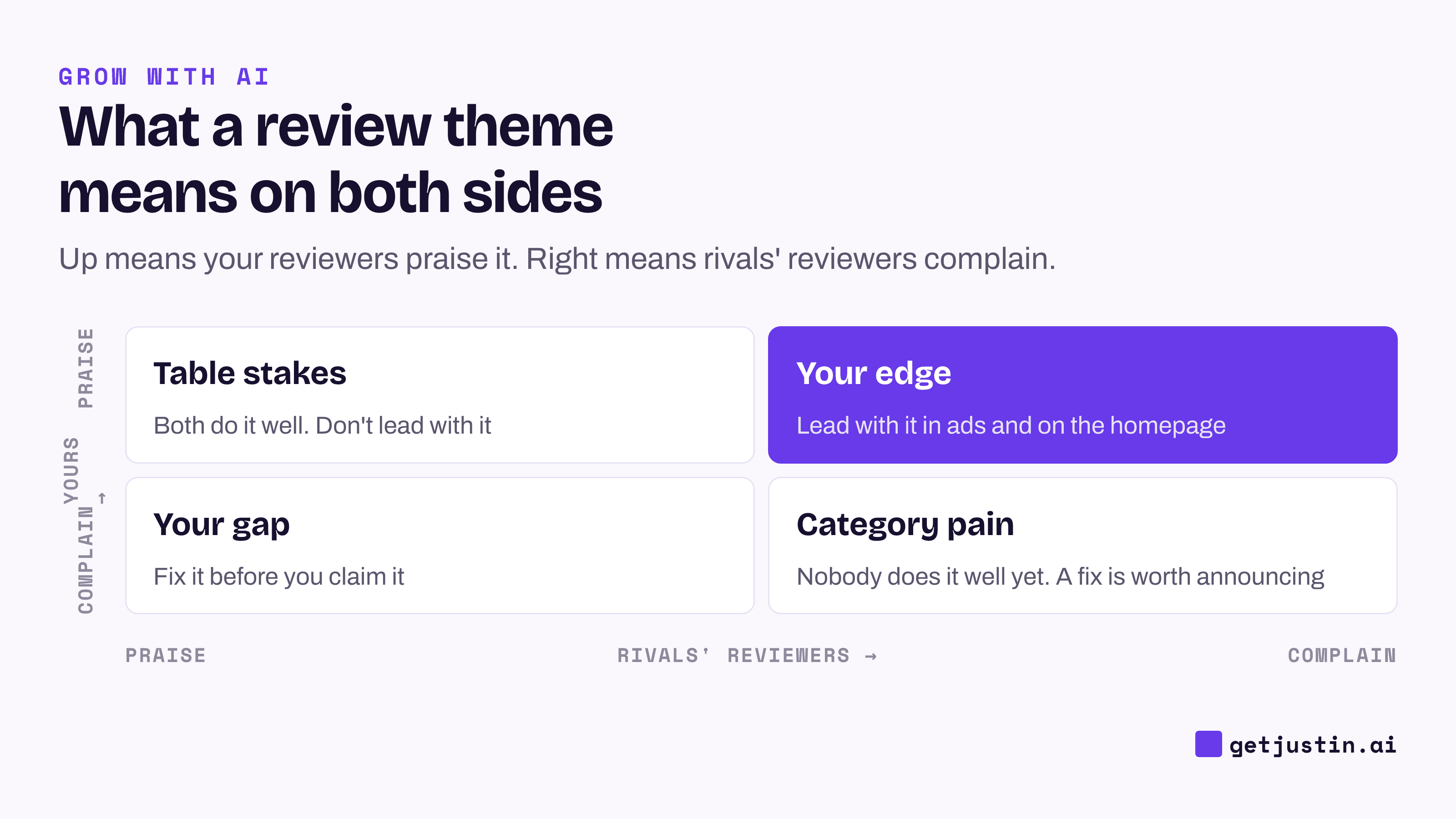
Figure: A theme means something different depending on what your reviewers and theirs say about it.
Your edge (they get complaints, you get praise): use the customers’ own words in ads and landing pages. Competitor ad research shows whether a rival is already claiming the same thing.
Your gap (they get praise, you get complaints): fix it, or stop claiming it.
Category pain (both get complaints): a real fix is a story worth telling.
Table stakes (both get praise): necessary, but not a reason to choose you.
Switching stories deserve their own pass. Reviews that say “we moved from X because” tell you exactly which buying moment a rival lost, which is worth more than any theme count. They also feed content gap analysis with AI, because the questions switchers asked are the ones a rival’s pages failed to answer.
FAQ
Can ChatGPT analyze customer reviews?
Yes, for a few hundred reviews at a time, if you paste them with date, rating and source. Ask for exact quotes and one row per point, then open a random sample of reviews to confirm the quotes are real. Chat assistants are weaker at exact counts across large batches, so count distinct reviewers in a sheet.
How many reviews do you need for review analysis?
Enough that each theme you act on comes from several distinct reviewers, not one. For most small brands that means the last six to twelve months of reviews per brand. Older reviews often describe a product version that no longer exists.
How do you analyze competitor reviews?
Collect a recent sample for two or three competitors, extract every point with the reviewer’s exact words, and use the same theme list for them and for you. Then compare theme by theme: where they get complaints and you get praise is your edge, and the reverse is your gap.
What is social listening with AI?
Social listening with AI applies review mining to posts, comments and forum threads that mention a brand or category. The AI groups what people say and pulls representative quotes. Because social posts are fewer and noisier than reviews, treat them as a check on themes you have already seen, not as proof.
Doing this with Justin
Justin, the AI coworker for Slack, can run the extraction and counting in a channel like #growth. Share your own reviews as a CSV export, point it at each rival’s public review pages, and ask for one row per point with exact quotes and links. Connect Zendesk or Intercom so it can add the complaints your customers send support. Ask for the theme counts as a live page. It shows when its data was last updated, and you can ask Justin to label where each number comes from. For the monthly pass, ask for an automation that rereads those review pages on the first Monday of each month and posts the themes that changed, and ask Justin to read the schedule back before it sets it up.
Related reading
From prompt library to skills library: collect your team’s best workflows