

Short answer: An AI SEO workflow for a small team splits the work at three gates. The AI reads the ranking pages, drafts the brief and the post, and runs the mechanical checks; a person approves the brief, verifies every fact and decides what gets published. The rule that holds it together: no original element, no post.
Most guides to AI SEO are tool tours that promise more posts per week. Volume is the easy part now. Making each post worth reading is not. Getting your brand mentioned in ChatGPT answers is a related but separate job; this guide stops at the published post.
What does an AI coworker do in SEO, and what stays with you?
The AI coworker takes the reading and the first pass at every artifact. You keep the decisions that carry risk: whether a post is worth writing, whether its facts are true, and whether it ships. The table below works as a template for splitting the job on a two-person team.
Step | The AI coworker does | You do | Gate |
|---|---|---|---|
1. Keyword map | Groups keywords by intent, one post per question, marks volumes as estimates | Pick the questions your buyers really ask | None |
2. SERP notes | Reads the top 3–5 pages and notes what each covers and misses | Add what sales and support hear | None |
3. Brief | Drafts the thesis, H2 questions, sources, internal links, word ceiling | Name the original element, or kill the post | Brief approval |
4. Draft | Writes from the brief and the supplied sources only | Nothing yet | None |
5. Checks | Runs structure, phrase, overlap and source checks | Open the source behind every number | Fact check |
6. Publish | Formats, writes meta title, description and alt text | Read it as a buyer would, then approve | Publish |
7. Refresh | Flags posts that slipped at 30 and 90 days | Update, merge or retire | None |
The other setup you’ll read about is an agentic SEO stack: the SEO tool’s data piped straight into an AI assistant through MCP, the standard that connects AI tools to other software. Semrush, for example, offers an official MCP server that connects assistants such as ChatGPT and Claude to live Semrush data. That speeds up the reading in steps 1 and 2, but it doesn’t replace the gates. A small team still needs a person to approve the brief, open the sources and decide what ships.
The AI SEO workflow, step by step
Each step hands the next one a file, and the brief is where a person saves the most work. The diagram below shows the order and the gates.
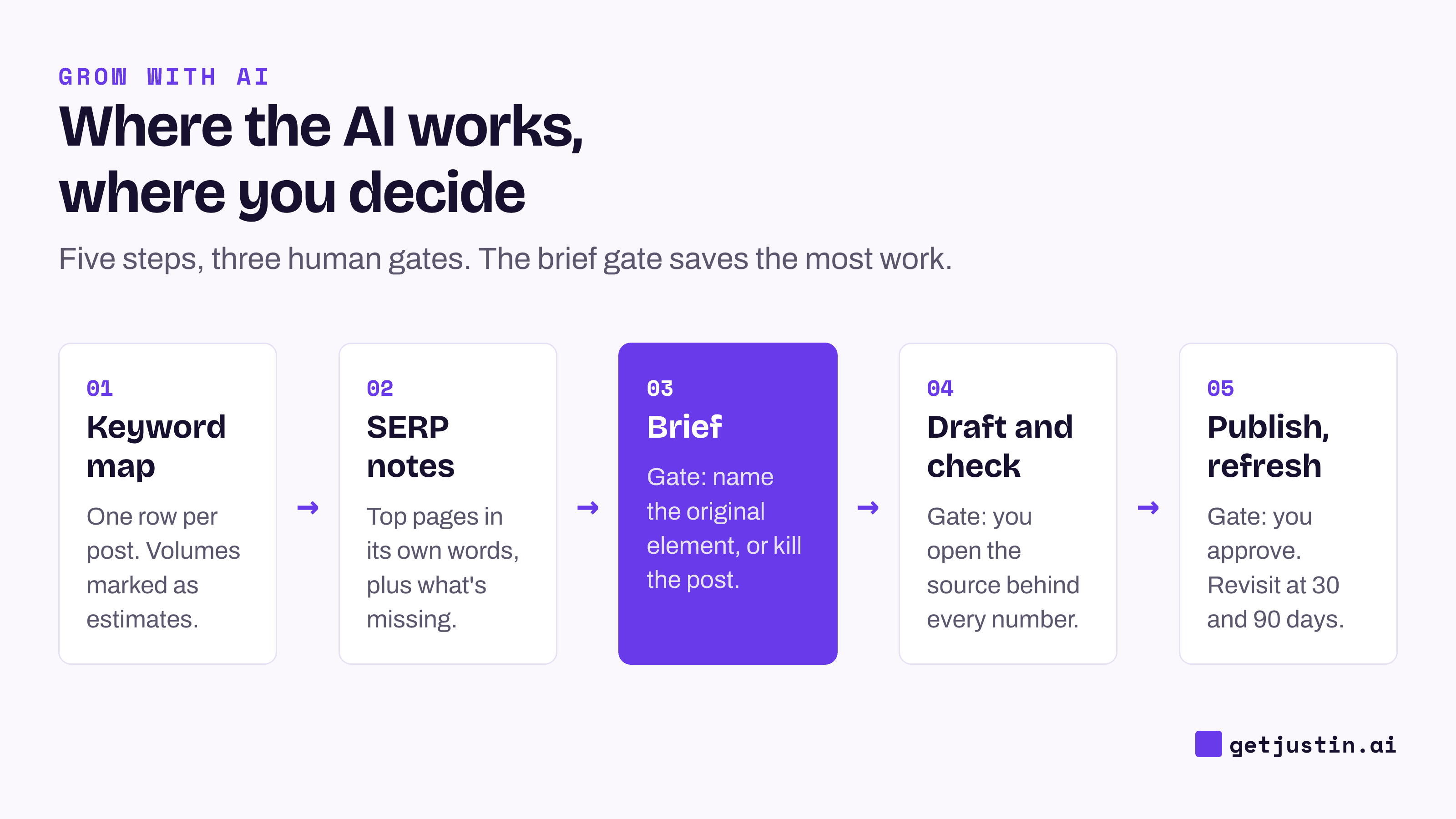
Figure: The AI carries the reading and drafting; the brief is the gate that decides whether a post exists.
Keyword map. One row per post: primary keyword, one or two secondaries, intent, and the hub page it links to. Any volume that didn’t come from Keyword Planner or Search Console is labelled an estimate, because an AI’s guess reads as precise. Content gap analysis with AI covers how to find the rows worth adding.
SERP notes. The AI writes notes on the top pages in its own words: headings covered, format, and what each page leaves out. That last column becomes your angle. Keep the URLs, because step 5 checks the draft against them. The counting method is the one from competitor research with AI.
Brief. The brief must name the original element: a number from your own data, a story from doing the work, a real screenshot, a template nobody else offers. Make that a hard rule: if the brief can’t name one, the post doesn’t get written. Killing a post at the brief costs one short conversation; killing it after the edit costs the whole draft.
Write the rules down before the first draft
Any AI content workflow drafts to whatever standard it’s given, so the standard has to exist in writing first. Every correction after that should become a rule, not a comment on one post.
Give the AI coworker a small kit: an editorial guide, a template, the product claims it may make, a bank of your team’s first-hand stories and a list of banned phrases. Run a pilot batch before the real calendar, and add what you correct as dated rulings at the bottom of the guide that override anything above them, so no fix gets made twice. On our CS team, every correction we give the AI becomes a written rule with the incident behind it, which is how one-off feedback turned into standing behavior.
The banned-phrase list earns its place fastest. On our CS team, we kept a list of strings that made the expert wince, and called it “the cheapest QA gate you’ll ever write.” It grew to 14 entries and stopped; the first batch of output had hundreds of hits and the second had none. For content, fill yours with competitors’ signature phrases plus the usual AI filler, and fail any draft that contains one. Writing AI skills for non-technical teams applies the same habit to any repeated task.
Checks an AI can run on every draft
Mechanical checks catch most of what makes an AI draft sound copied or machine-made, and they run in seconds, before a person reads a word, so review time goes to judgment.
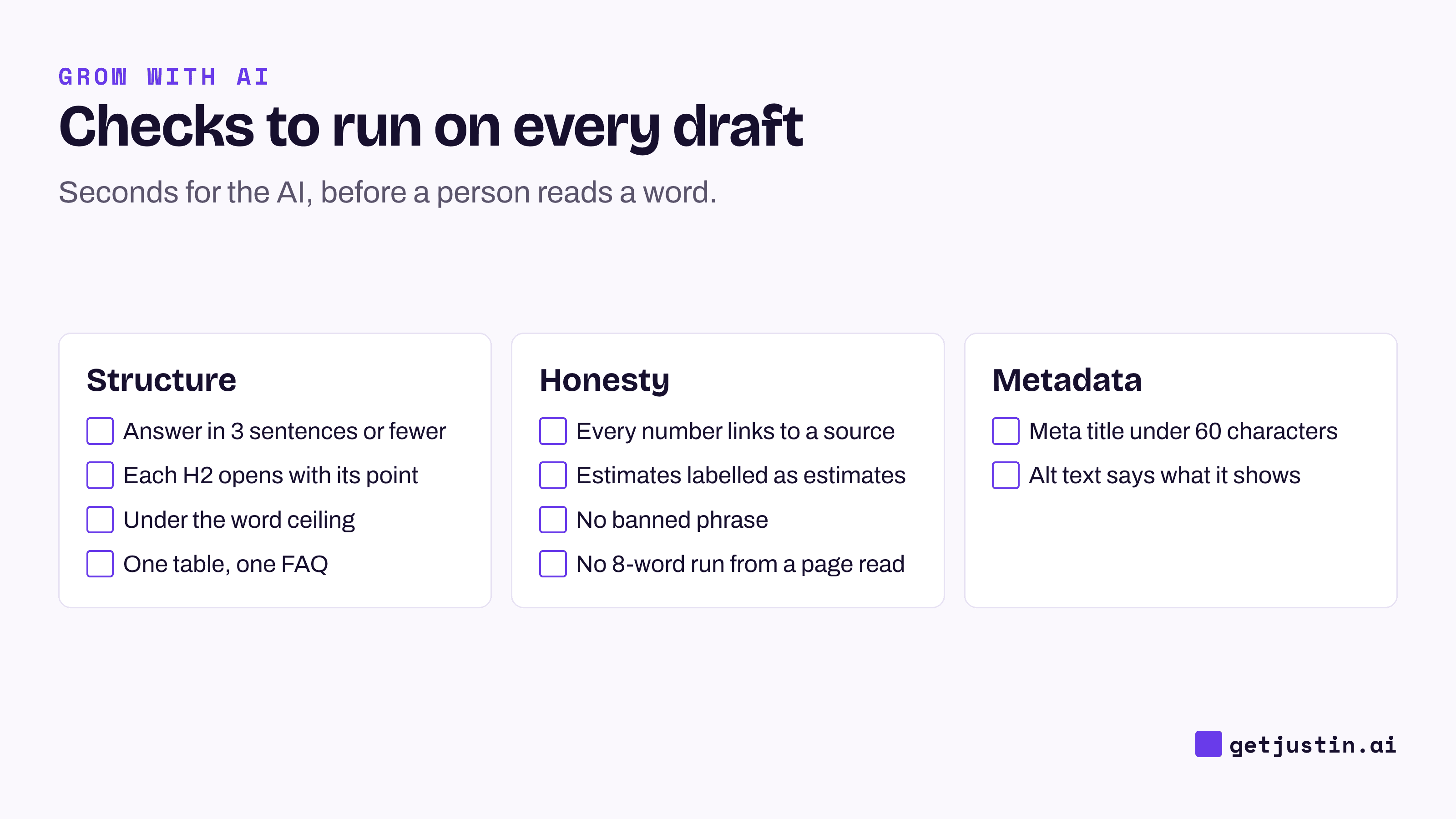
Figure: Ten checks a script or an AI can run on every draft, before anyone edits it.
The overlap check is the one most teams skip. Compare each draft against every page in its SERP notes, plus any competitor posts you’ve collected, and fail any run of eight or more words in common. Exempt marked, linked quotes.
Metadata gets the same scrutiny as body copy; Google’s guidance on AI content names titles, meta descriptions and alt text (Google Search Central, updated December 2025).
The checks can’t tell you whether a fact is true, so have the AI flag each draft for the editor: a fact it couldn’t confirm, a story the author hasn’t approved. The fact check starts there.
Where SEO with AI goes wrong for small teams
Most failures come from four habits: volume without originality, invented numbers, copied structure and impatience.
Volume. Google’s spam policy covers using AI to generate “many pages without adding value for users” (Google Search Central). Ten near-identical posts are a risk, not a strategy.
Invented numbers. A number either links to its primary source or is labelled “Example:”. There is no third option.
Sameness. Copying the top page’s H2 order produces the page Google already has. Reorder, merge, and add the section the others miss.
Impatience. Ahrefs found that only 1.74% of newly published pages reached the top 10 within a year (Ahrefs, 2025). Faster drafting doesn’t change that.
An honest limit: no workflow, AI-assisted or not, makes a new page rank fast, and the checks prove a draft is clean, not that it will rank. The Ahrefs figure is the reason to plan refreshes from day one, rather than judging a post in its first month.
FAQ
What is an AI SEO workflow?
An AI SEO workflow is a content process where an AI does the reading, briefing, drafting and mechanical checks, and people own the decisions: approving the brief, checking the facts and approving publication. It works best with written rules the AI drafts against.
Does Google penalize AI-written content?
Google’s guidance says AI-generated content is judged like any other content. The risk is its spam policy on scaled content abuse: many pages made mainly to rank, with little originality or added value. Original data, first-hand experience and a real review step keep AI-assisted posts on the right side.
What should an SEO content brief include?
The primary keyword and intent, the reader, a conclusion-first thesis, the H2 questions, required sources, internal links, a word ceiling and the original element. If you can’t name the original element, don’t approve the brief.
How do you check an AI draft for copied text?
Compare the draft with every page the AI read for it, and fail any run of eight or more words in common, exempting marked, linked quotes. A short script does this in seconds. It catches copied sentences, not copied structure, so a person still checks that the H2 order isn’t the top page’s.
Doing this with Justin
Justin, the AI coworker for Slack, can run the middle of this workflow in a #content channel. Invite it there and share your editorial guide and banned-phrase list as files; ask it to remember a correction, and it keeps it for the team. Connect Google Sheets for the keyword map and Notion for drafts. Then @-mention it with a keyword row and the URLs of the top-ranking pages; it reads each page, cites it in the SERP notes and drafts the brief. It replies in a thread, so the brief approval happens there. Saving a draft into Notion is a write, so it asks before acting. For the refresh step, ask for an automation: on the first Monday of each month, compare blog landing-page sessions in Google Analytics and post the pages that dropped.