

Short answer: Content gap analysis with AI means giving an AI your pages, your competitors’ pages and your customers’ real questions, then asking it to list what you are missing, with a link as evidence for each gap. The AI is fast at reading and comparing hundreds of pages. It is unreliable on search volumes and on whether a rival page truly answers a question, so check both before you assign a writer.
Most gap guides stop at a keyword gap tool: export the terms competitors rank for and you don’t, then sort by volume. That finds one kind of gap out of four.
What counts as a content gap?
A content gap is any question your buyers have that your site answers worse than a competitor’s, or not at all.
Gap type | What it looks like | Where to find it | Usual fix |
|---|---|---|---|
Missing topic | Rivals have a page for a question; you have none | Competitor sitemaps, keyword gap tools (Semrush, Ahrefs) | A new page |
Weak page | Your page gets impressions but few clicks, or sits on page two | Rewrite the answer and the title | |
Format gap | Everyone covers the topic the same way | Counting rival pages: tables, images, tools, FAQs | Same topic, a format nobody has |
Answer gap | Customers keep asking, and answers are missing or inconsistent | Support tickets, sales calls, reviews | One agreed answer, then a page |
AI finds format gaps best, because finding them takes counting. When we counted competitor blogs before planning our own content, the gap wasn’t a topic: almost nobody used original diagrams. The guide to competitor research with AI covers that count.
How to run a content gap analysis with AI, step by step
A content gap analysis with AI takes five steps, and the AI carries the middle three, as the diagram below shows.
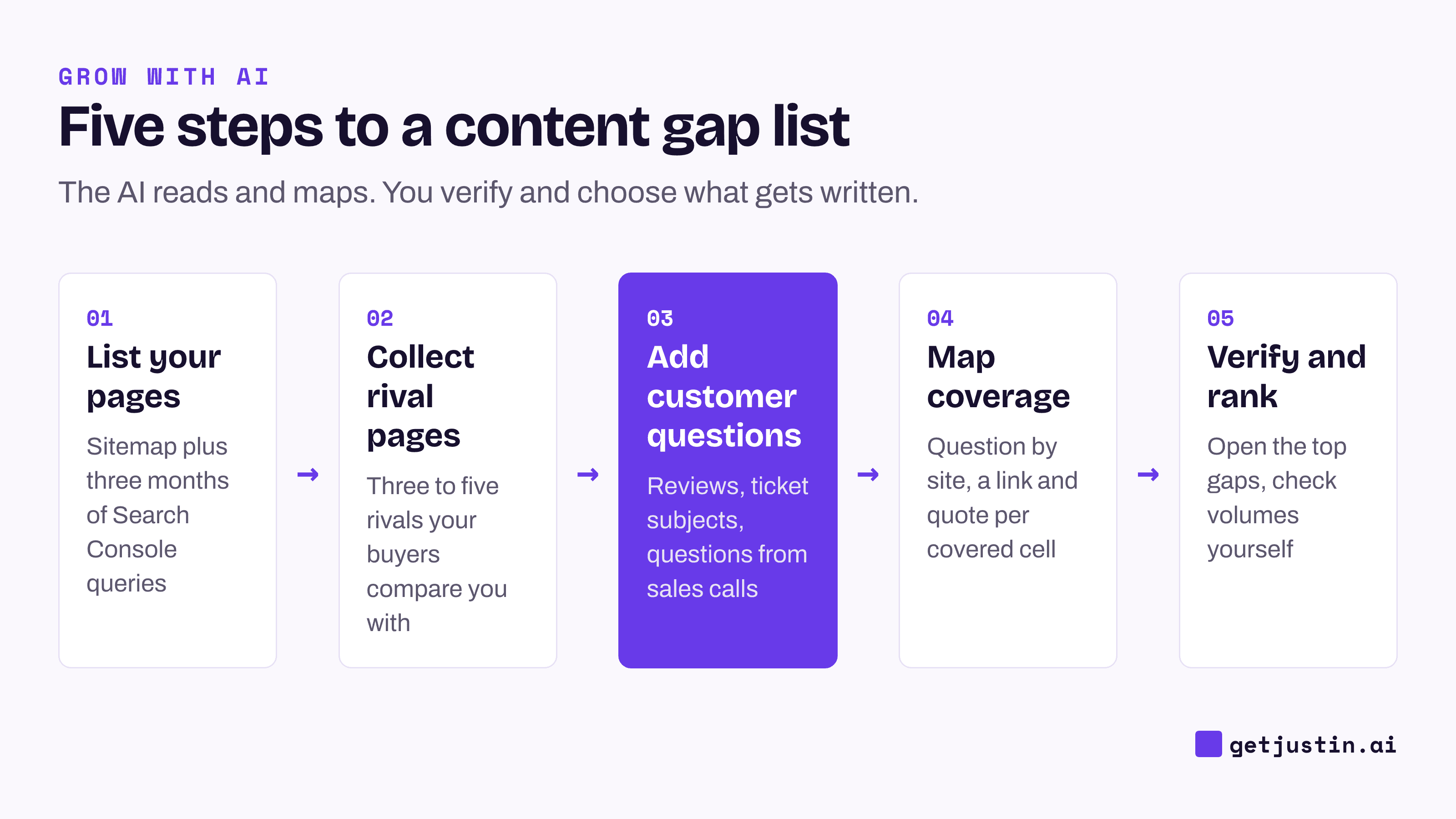
Figure: The AI does the reading and mapping; you choose which gaps are worth a writer’s week.
List your own pages. Export your sitemap and three months of Search Console queries, so the AI compares against what you have, not what it remembers about your site.
Collect three to five rivals’ pages. Pick the competitors your buyers really compare you with; their sitemaps give the full list.
Add your customers’ questions. Review excerpts, support ticket subjects, questions from sales calls. Competitors can’t copy this source.
Map coverage. One table: each question a row, each site a column. A cell counts as “covered” only when a page answers the question, not when it mentions the term.
Verify and rank. Open the pages behind your top ten gaps, check volumes in a keyword tool yourself, then rank with the matrix below.
Keep the step 4 prompt plain: “Here are our pages, three competitors’ pages and our customer questions. Group the questions into topics. For each topic, say which sites answer it, link the page, and quote the sentence that answers it.” The quoted sentence is the cheapest check against a made-up “covered”.
If AI assistants cite a rival for a question you answer, that is a gap too; see how to get your brand mentioned in ChatGPT answers.
Your customers’ questions are the gap list competitors can’t see
Customer questions find the gaps that matter most, because they come from people close to buying. A keyword tool shows what the market searches; tickets and calls show where your buyers get stuck. Most content gap templates you’ll find are keyword gap spreadsheets, with volume, difficulty and intent columns, and a question that only lives in your support queue never shows up in them.
On our CS team, we had the AI mine raw meeting transcripts for a voice-of-customer study: 1,351 client questions from 222 meetings across 119 companies. We ranked topics by how many distinct companies asked, never by raw mentions. The headline wasn’t a missing article. 140 questions got materially different answers depending on which CSM was in the room.
That changed what we count as a gap. An answer gap is often a consistency gap: the content exists in three people’s heads, in three versions. The fix is one agreed answer first, then a page, because writing the post before the team agrees just publishes a fourth version. AI customer review analysis applies the same method to public reviews.
Which gaps are worth filling first?
Rank gaps by how many of your buyers ask and how well competitors already answer. Search volume from a keyword tool is a tiebreaker, not the ranking.
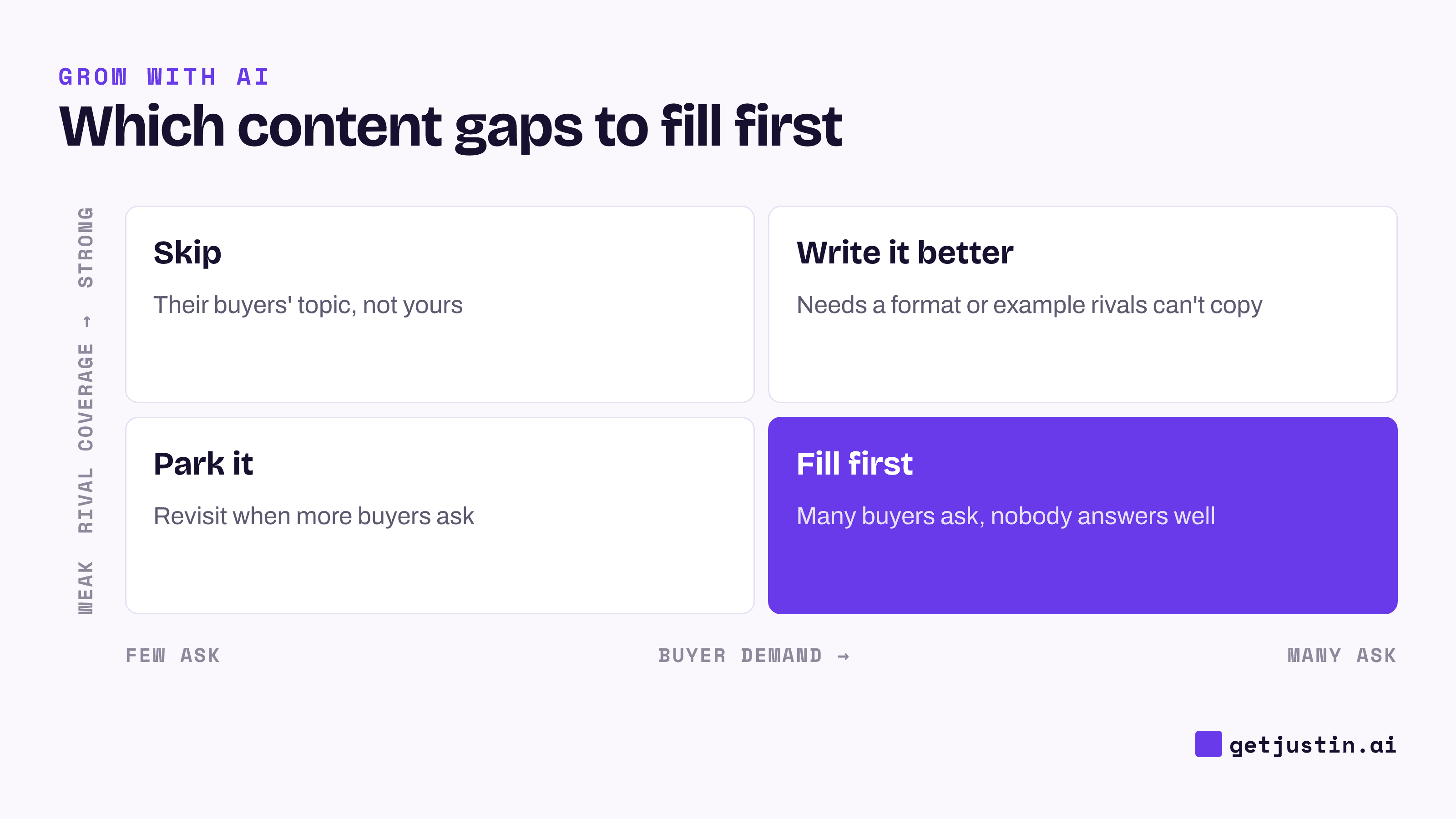
Figure: Start where many buyers ask and competitors answer weakly.
A gap competitors already answer well isn’t closed. It needs something they can’t copy, such as a first-hand example or a working template. If you can’t name that thing, park it.
What does AI get wrong in content gap analysis?
AI makes four mistakes in gap work often enough that each needs its own check.
Search volumes. A chat assistant will give a volume for any keyword. Unless it read the number from a tool you connected, treat it as an estimate and check it in Keyword Planner.
Covered versus mentioned. A rival page that uses a term once doesn’t answer the question; the quoted-sentence rule from step 4 catches most of these.
Stale pages. The AI may describe a competitor page as it was months ago. Open it.
Other buyers’ gaps. A rival selling to enterprises has pages your buyers never need. Filter by what your customers asked.
A content gap analysis template
Every row in a content gap analysis template should carry its evidence, so anyone can check it without asking you. One row per gap:
Gap | Type | Evidence | Who asks | Rival coverage | Our fix | Owner | Unverified |
|---|---|---|---|---|---|---|---|
Example: “How long until results show?” | Answer gap | 3 ticket links, 2 call notes | 9 distinct companies | One rival, one vague paragraph | Agree the answer with CS, then a short page | Content lead | Search volume |
Example: “New-user setup checklist” | Format gap | Rival pages are text only | 4 distinct companies | Two rivals, no checklist | A checklist page with a copyable version | Lifecycle marketer | None |
Once gaps turn into a writing plan, the AI SEO workflow takes each one from keyword to published post, through three human gates: brief, fact check and publish.
FAQ
What is a content gap analysis?
A content gap analysis compares the questions your buyers ask with the pages that answer them, on your site and your competitors’. The output is a ranked list of topics to add, pages to rewrite and formats to try. Each gap should link to the evidence behind it.
Can ChatGPT do a content gap analysis?
Yes, if you give it the inputs: your page list, competitors’ pages and your customers’ questions. It groups topics and compares coverage well. It is weak on search volumes and can misjudge whether a page answers a question, so ask it to quote the answering sentence and check volumes in a keyword tool.
What is the difference between a keyword gap and a content gap?
A keyword gap is the list of search terms competitors rank for and you don’t. A content gap is broader: weak pages you already have, formats nobody in your category uses, and customer questions no page answers well. The keyword gap is one input to a content gap analysis.
How do you find a competitor content gap?
Run the same map from the other side: list the questions your customers ask that a competitor doesn’t answer, or answers vaguely. Check their help center and FAQ as well as their blog. Those topics are where you can become the best page fastest.
Doing this with Justin
Justin, the AI coworker for Slack, can run the collect and mapping steps in a channel like #content. Point it at your sitemap and three rivals’ sitemaps; it reads the pages, and you can ask it to link its sources. Share a Search Console export as a file, and connect Zendesk or Intercom so it can read the questions customers actually ask. Ask for the coverage table as a live page: it shows when its data was last updated, you can ask Justin to label where each number comes from, and the link stays the same when you ask for changes. Keep the gap log in Google Sheets. Reading doesn’t need approval, and Justin asks in the channel before it writes a row. For the next round, ask for an automation that posts new ticket questions to #content every Monday.