

Short answer: Competitor research with AI works when you start from one decision, let the AI read and count far more competitor material than you could, and check every finding you plan to act on against its original page. In one afternoon, about four hours, you can scope the question, collect sources for three to five competitors, count patterns, verify, and end with a one-page brief that says what changes.
Most guides hand you a SWOT grid and a prompt to fill it. AI changes two things: how much you can read in an afternoon, and how fluently a wrong answer gets written. A good plan uses the first and guards against the second.
Why start with a decision, not a list of competitors?
Competitor research is worth an afternoon only if it changes a decision you are about to make. “Research our top competitors” produces a profile of each one that nobody opens twice. “Should we add a starter bundle before Q4?” produces a short list of things to check: pricing pages, what reviewers say about price, which ads lead with a discount.
Write the decision as one sentence. Then name the three to five competitors a lost customer actually chose instead, which are rarely the biggest names in the category.
Before we wrote the docs for a product launch, we had our AI coworker benchmark how nine general products and our closest peers documented something similar. The finding that changed our docs: users struggle with cryptic field names, and the fix is to hide the schema, with plain-language metric definitions first and a full metric catalog later. Use the AI for breadth, then keep only what changes a decision.
The one-afternoon plan for competitor research with AI
The afternoon has five blocks, and verification is the one people skip. The diagram below shows the order and a rough time for each.
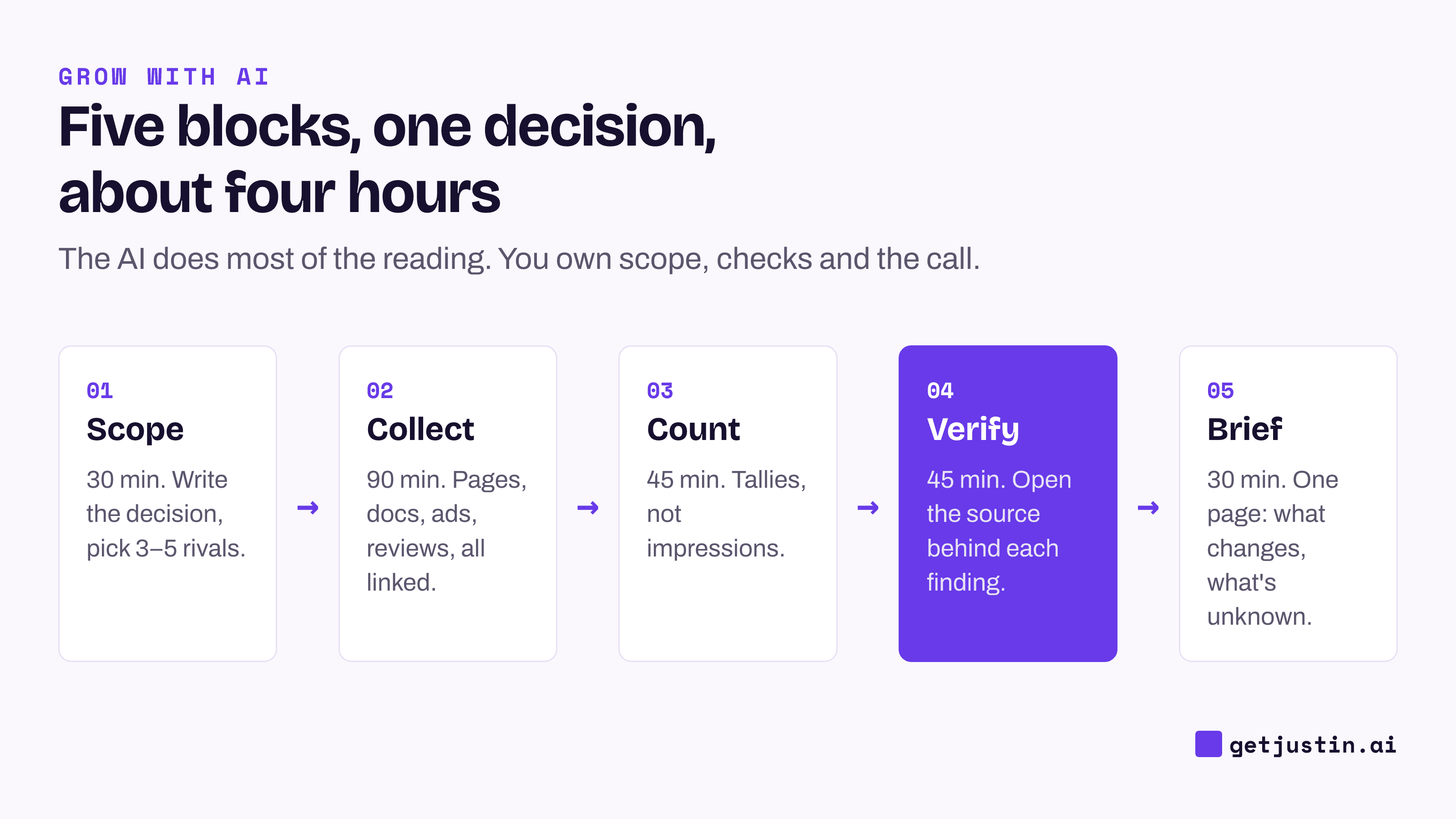
Figure: The AI does most of the reading; you own the scope, the checks and the call.
Scope (30 minutes). Give the AI the decision and the competitor list, and ask it for four or five questions before it starts. One line from the tips our CS ops lead wrote for the team: the AI never says “I’m not sure what you mean.” It fills the gap with a guess you only find in the output.
Collect (90 minutes). Have it gather each competitor’s homepage, pricing page, help docs, changelog, current ads and a sample of reviews. Every item gets a link and the date it was read.
Count (45 minutes). Ask for tallies, not impressions: how many ads lead with price, how many reviews mention setup, how many plans each rival sells.
Verify (45 minutes). Open the source behind every finding you might act on. Start with prices and anything dated, because that is where AI answers go stale first.
Brief (30 minutes). Ask for one page, conclusion first. Then decide yourself what changes.
The AI carries blocks 2 and 3. You carry blocks 1, 4 and 5, and that split is the point.
Where to look: sources that show what competitors actually do
A competitor’s homepage shows what they want you to believe; their docs, ads and reviews show what they do. Give the AI all of them and tell it to label which source each finding came from, so a marketing claim never gets reported as a fact.
Source | What it shows | What it can’t tell you |
|---|---|---|
Homepage and pricing page | Positioning, plans, the promise they lead with | Whether customers believe it |
Help docs and changelog | What the product really does, recent launches, stated limits | Whether anyone uses the new feature |
Public ad libraries: Meta’s Ad Library and Google’s Ads Transparency Center | Ads running now, formats, how long each has run | Spend or results |
Reviews (G2, Trustpilot, app stores, Amazon) | Recurring praise and complaints in customers’ own words | How common a complaint is among people who never review |
Search results and AI answers | Who shows up for the questions your buyers ask | Real traffic; tool figures are estimates |
Job posts | Where they are hiring, a hint at where they are investing | Timing or budget |
Read the docs even when the homepage seems clear. A landing page and its documentation can disagree, for example on whether the product can change your data. When they do, record both and treat the gap itself as a finding.
Each row has its own method. See how to research competitor ads, AI customer review analysis and getting your brand mentioned in ChatGPT answers. When the question is why one rival is suddenly winning, competitor growth analysis lines these sources up by date.
Count, don’t skim: the AI’s real advantage
The biggest advantage of AI competitor analysis is that the AI can count across hundreds of pages while you skim five. Skimming gives you an impression of the leader; counting gives you the category’s pattern.
Before we planned our own content, we had our AI coworker collect about 440 posts from eleven competitor blogs and tally their structure instead of summarizing them: length, headings, and whether each post had an FAQ, a table or an image. Three of the most search-focused sites kept median posts between about 1,300 and 1,900 words; several others ran past 3,000. Among the search-focused sites an FAQ was nearly universal, and most used tables. Original diagrams were rare, and the blog with the most posts had a median of zero images.
Then it counted phrases. Some recurred in a fifth or more of one company’s posts, which makes them that company’s voice, not the category’s, so they went on a list of phrases we don’t use. The counting settled three things: an FAQ and a table are table stakes, shorter is fine, and diagrams are the gap. The same research opened with its own caveat: only six of our target keywords had published search volumes, so every other number was marked as an estimate.
Content gap analysis with AI applies the same counting to topics competitors cover and you don’t.
How do you check what the AI tells you?
AI summaries of competitors are leads, not evidence, so check anything you will act on against the original page.
We learned this on customer research. Our meeting summaries carried an AI-extracted list of “customer questions.” When our CS ops lead audited them against the raw transcripts of 63 demo calls, about four in ten were the salesperson’s own narration, rewritten as questions. Since then we rank themes by how many distinct companies raise them, never by raw mentions, “or one chatty account manufactures a theme.” The same rule holds for reviews and ads: count distinct reviewers or advertisers, not mentions.
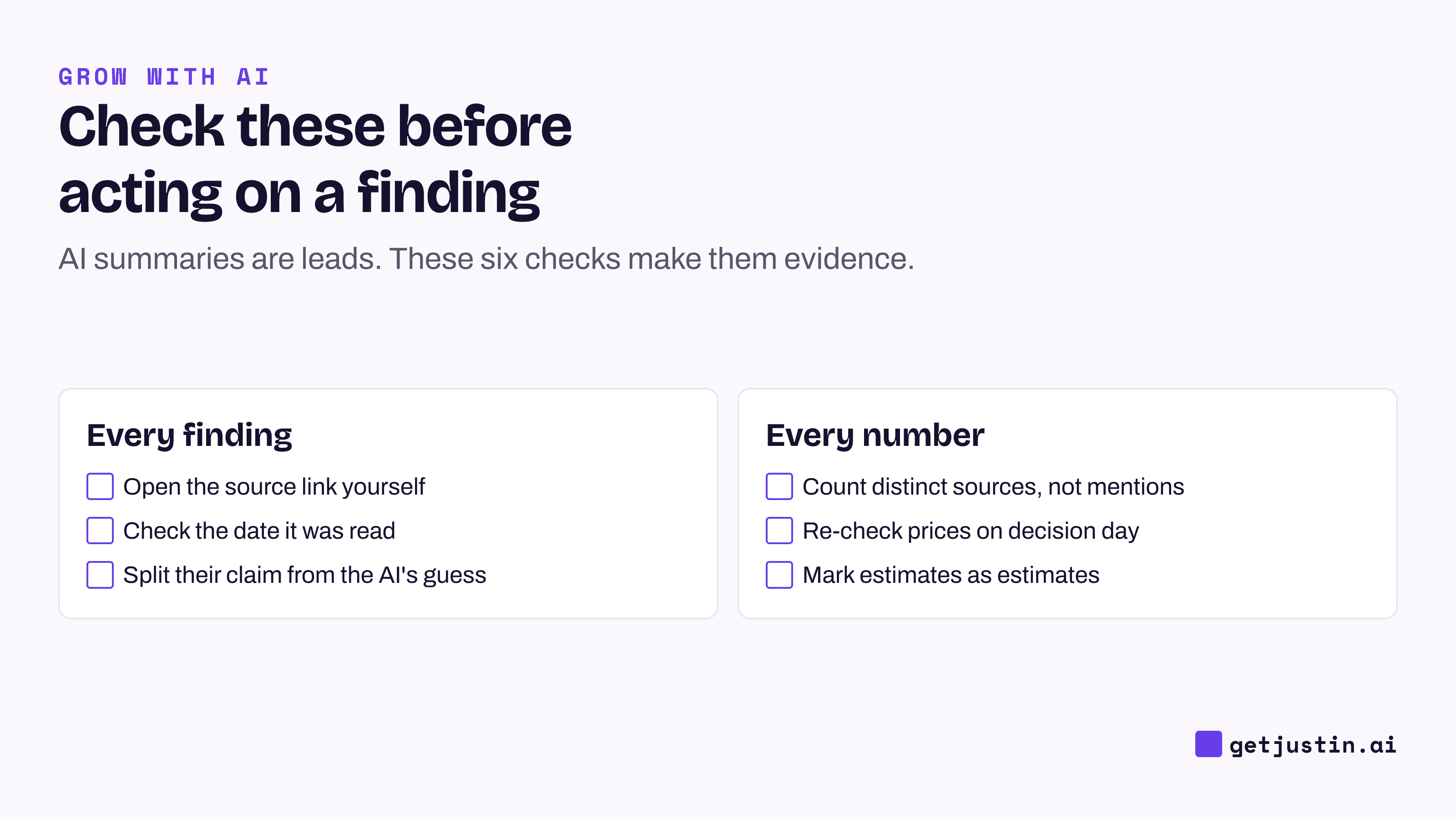
Figure: Six checks turn an AI summary into a finding you can act on.
For every finding, open the source link yourself, check the date it was read, and separate the competitor’s own claim from the AI’s guess. For every number, count distinct sources rather than mentions, re-check prices on the day you decide, and mark estimates as estimates.
A one-page competitor analysis template
The deliverable is one page with the conclusion first, because the research-first document is the one nobody finishes. The last two rows are where honest research shows.
Section | What goes in it | Example (illustrative) |
|---|---|---|
Decision | The one question this research answers | Should Acme, a 12-person DTC brand, add a starter bundle under $40 before Q4? |
Answer | Yes, no or not yet, in one sentence | Not yet: one of four rivals sells one, and its reviews complain about what’s inside |
What we found | Three to five findings, each with a link and read date | Rival B’s bundle ads have run since early August (ad library, read Sep 22) |
What changes | Each action, with one owner | Test a bundle in email only; the lifecycle lead owns it |
Still unknown | What the research could not answer | Whether Rival B’s bundle made money |
Estimates | Every number that isn’t from a primary source | Rival traffic figures come from a third-party tool |
Between decisions, run the same checks on a schedule; automating competitor monitoring in Slack shows the weekly version.
FAQ
Can ChatGPT do competitor research?
Yes, for breadth. A chat assistant with web access can gather pages, summarize positioning and draft a comparison table quickly. Its weak spots are prices, dates and recent changes, and it rarely says when it is unsure. Ask for a link on every claim and open the ones you plan to act on.
How many competitors should an AI competitor analysis include?
Three to five for a decision, chosen by who your lost customers picked instead. Counting work is the exception. To find a pattern in ads, reviews or blog posts, a sample across ten or more companies is cheap for an AI and more reliable than a close read of the leader.
What should a competitor analysis template include?
The decision, a one-line answer, three to five findings with links and dates, what changes and who owns it, what is still unknown, and which numbers are estimates. Leave out the SWOT grid unless someone will act on it.
How often should you redo competitor research?
Run a full afternoon when a decision is due, such as pricing, a launch or a new channel. Between decisions, a light weekly check of pricing pages, new ads and new reviews catches most changes. That check should say nothing when nothing changed.
Doing this with Justin
Justin, the AI coworker for Slack, can take the collect, count and brief blocks in the channel your team already uses. Invite it to #growth, @-mention it with the decision and your competitor list, and point it at each rival’s pricing page, help docs and changelog; it reads each page, and you can ask it to link its sources. Share ad screenshots or a review export as files. It replies in a thread, so teammates can follow up there without a mention. Ask for the brief as a live page, and ask where any number came from. For the weekly check, ask for an automation that reads those pricing pages and changelogs every Monday and posts only what changed. Justin uses large language models; its output can be wrong or incomplete — check anything consequential before you act on it.
Related reading
Why is that brand growing? Reverse-engineer a competitor’s growth
See every ad your competitors are running (and what it tells you)