

Short answer: Build the skills that eat Monday mornings first, and start with the ones that only read data: a weekly performance recap, a budget-pacing alert, a metric-drop alert and a pre-launch campaign check. Add drafting skills such as copy checks and content briefs next, and leave anything that sends a message or changes a live campaign until last.
Search for AI skills for marketing teams and half the results are about what marketers should learn. This list is the other meaning: skills you write for an AI coworker, a written playbook it follows every time a job comes up. This piece covers which ten to build, in what order, and the judgment each one needs.
Why should a marketing team build skills first?
A marketing team is a good first team because its repeated work is weekly, numeric and spread across several tools, and most of it only reads data. A wrong figure in a recap gets caught in the channel before anyone acts on it. And the marketer who did the recap by hand last week knows the right answer, which is what makes a skill testable.
The data pull is the easy part to write down; the judgment a senior marketer would add is the part worth writing down. Each skill below names the judgment that makes it good.
The 10 AI skills for marketing teams
The table lists each skill with what starts it, what it reads, what it delivers and its action tier. “Read” and “draft” skills change nothing; “write” means a person approves before anything changes. The first three each have a full setup guide, linked in the table.
# | Skill | Trigger | Reads | Delivers | Tier |
|---|---|---|---|---|---|
1 | Monday 8:00 | GA4, ad platforms, Shopify | Recap in the team channel, conclusion first | Read | |
2 | Daily | Ad platforms, budget sheet | Alert only when a campaign is off pace | Read | |
3 | Daily | GA4, Shopify | Alert when a key metric falls past a threshold | Read | |
4 | Pre-launch campaign check | Before each launch | Draft campaign, landing page, UTM sheet | Pass or fail list with the fix for each fail | Read |
5 | UTM and naming audit | Weekly | Ad platforms, GA4 source and medium | Broken tags and off-pattern names | Read, fixes are writes |
6 | Brand-voice copy check | On request | Draft copy, banned-phrase list | Flags and suggested rewrites | Draft |
7 | Content brief | On request | Target keyword, pages you share | Brief with outline and angle | Draft |
8 | Competitor ad watch | Weekly | Ad library exports you share | What changed since last week | Read |
9 | Review digest | Monthly | Reviews export, support tickets | Top themes with example quotes | Read |
10 | Monthly CEO report | Monthly | Outputs of skills 1 to 3 | One page, conclusion first | Draft |
The checklist below groups the same ten by when they run, which is how most teams schedule them.
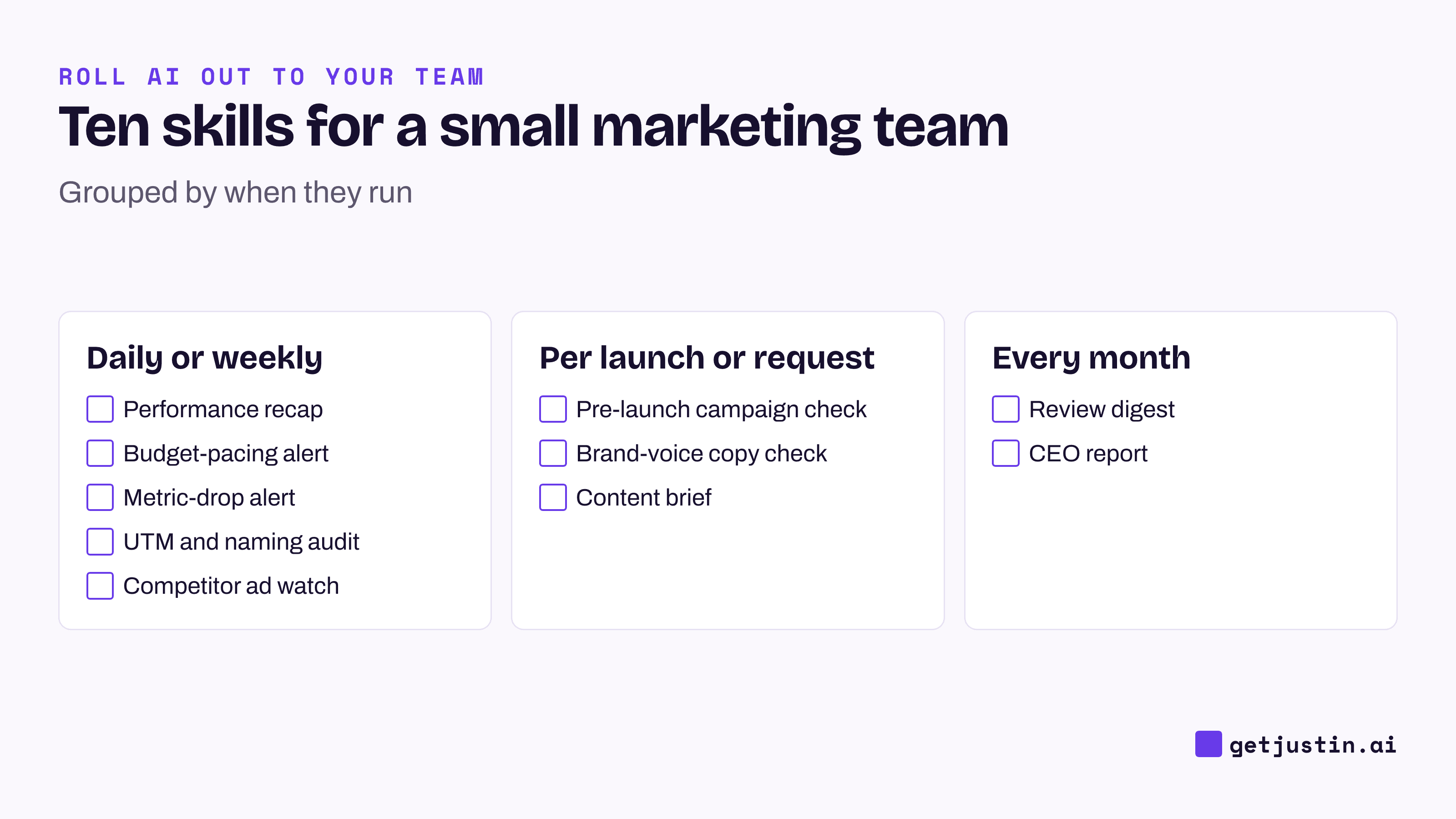
Figure: Five recurring skills, three on demand and two monthly ones cover most of a small team’s repeated work.
What makes each marketing skill good?
Each skill is only as good as the rule a senior marketer would add to it. These four came from running our own AI skills.
Recap: every metric ships with its interpretation rule. On our team, a new-customer return on ad spend below 1.0 is often expected on first orders; a blended figure below 1.0 is the real alarm. Write the bar next to each metric, or the skill flags the wrong one.
Recap: drafts show every row. On one of our dry runs, a generator silently cut a 13-row table to 7 and hid a channel carrying 18% of spend. Cutting is a person’s call at review, never the skill’s.
Pacing and drop alerts: flag, don’t act. Our weekly recap marks a bleeding campaign “investigate” and never pauses it, because “The machine is good at surfacing the candidate. It has not earned the irreversible call.” The metric-drop alert follows the same rule.
Copy check: keep a banned-phrase list. Every phrase that makes your best writer wince goes on it, and every draft is checked against it before a person reads it.
In what order should you build them?
Build one skill at a time, in four stages, and start the next only when the last one runs without hand fixes. The ladder below shows the order.
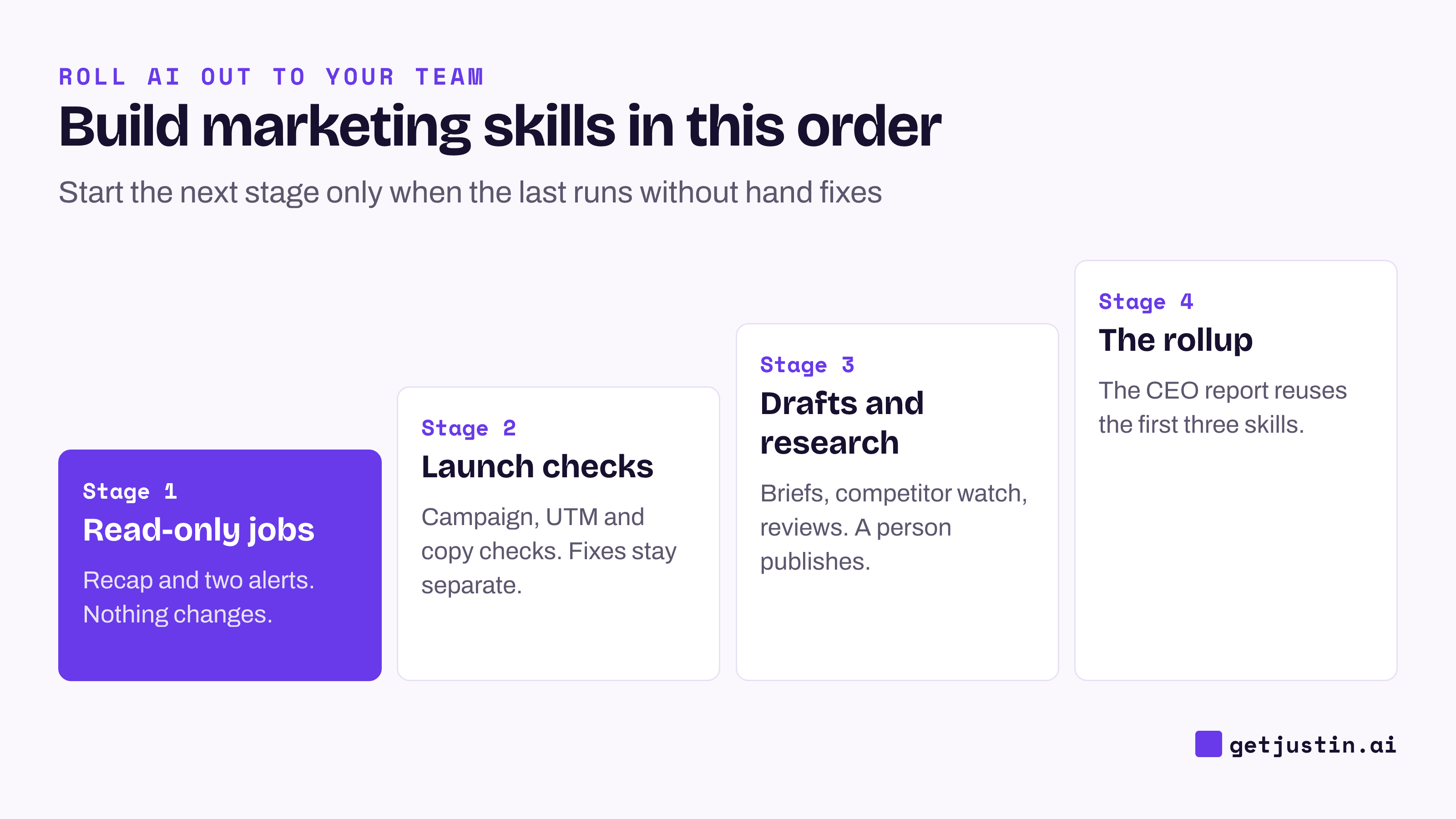
Figure: Build from read-only weekly jobs up to the rollup that depends on all of them.
Read-only weekly jobs (skills 1 to 3). The recap and alerts touch nothing, so they’re safe to run while you tune them.
Launch checks (4 to 6). These catch mistakes before money is spent. Keep fixes separate: the UTM audit lists broken tags, and changing them in the ad platform is its own approved action.
Drafts and research (7 to 9). A person always decides what gets published.
The rollup (10). The CEO report reuses the first three skills, so it comes last.
The order matters most for the rollup, because a rollup can’t be better than the pieces under it. Our own deck skill stalled for that reason: the interpretation rules it depended on had never been written down.
How do you measure time saved?
Measure time saved by timing the manual version once before you build, then counting runs and fixes afterward. Most time-saved figures are guesses made after the fact, so take the baseline first.
What to count | How | Healthy sign |
|---|---|---|
Manual baseline | Time the job by hand once | Example: a recap that takes 90 minutes |
Unprompted runs | Scheduled runs that delivered | Arrives every week without a reminder |
Asks by others | Requests from someone other than the author | The skill spreads beyond its builder |
Hand fixes | Outputs a person had to correct | Falls to zero, then stays there |
If hand fixes don’t fall after three or four runs, the skill’s instructions are missing a rule. Find the correction you keep making and write it in.
FAQ
What are Claude skills for marketing?
Claude skills for marketing are instruction folders, built on Anthropic’s Agent Skills format, that teach the model one marketing job, such as a recap or a copy check. Anthropic introduced the format in October 2025 and published it as an open standard that December (Anthropic, 2025). The idea carries across tools: a skill is a written playbook, and most of its value is the rules and examples in plain language.
What should you look for in an AI coworker for marketing?
Look for an AI coworker that works where the team already talks, reads your ad, analytics and store data, and asks before changing a live campaign. Pick the one that runs your first skill, usually the weekly recap, reliably. The comparison of AI agents for Slack covers the options, and what an AI marketing agent in Slack does walks through a week of that work.
Who on a marketing team should write the skills?
The person who does the job today should write its skill, because “the person closest to the work should be the one building the skill.” A performance marketer writes the pacing alert; the content lead writes the brief. A champion or ops person can help with setup.
How long does it take to build a marketing skill?
Plan on about a week for the first one: a day to write it and a few days of real runs and corrections. Later skills go faster because the team knows the pattern. A skill that still needs fixes after two weeks is usually too broad, so split it.
Doing this with Justin
Justin, the AI coworker for Slack, can run the first three of these as automations. Connect Google Analytics, Shopify or Google Sheets, then ask in one sentence, naming your time zone: “post a performance recap to #marketing every Monday at 8am New York time.” Ask Justin to read the terms back before it starts. Ask it to remember each metric’s interpretation rule, and it keeps it for the team. A reply under the report picks up from that report, and you can ask for a live page of the numbers; live pages show when their data was last updated, and you can ask where any number came from. It asks before it writes to your connected tools.
Related reading
AI agent skills for non-technical teams, and how to write your first one
From prompt library to skills library: collect your team’s best workflows
Anomaly alerts for marketing metrics: catch the drop before Monday