

Short answer: An automated monthly marketing report for a CEO pulls five numbers and drafts one line on why each moved; you write the headline and what happens next. Schedule it to reach you as a facts-only draft a few days after month-end. Then send the marketing report to your CEO under your own name.
Your CEO probably has a dashboard already, and a dashboard often goes unopened. The report is the other half: it says what needs attention and who owns it, and it arrives without anyone building it by hand each month.
What goes in a monthly marketing report for a CEO?
A monthly marketing report for a CEO has five blocks, and the headline decides whether anyone reads the other four.
Block | What it holds | Who writes it | Example: a 40-person DTC brand, August |
|---|---|---|---|
Headline | On track or not, and the one decision you need | You, from the draft | “Revenue 4% over plan. I’d like to move $5k from search to creator tests.” |
Five numbers | Each against target, last month and the same month last year | Automated | Net revenue, spend, new customers, blended CAC, returning-customer revenue |
Why it moved | One line per number that crossed its bar | Drafted, then edited by you | “New customers 6% under target: prospecting spend cut after Aug 14” |
Next month | What you’ll do, and what you need from the CEO | You | “Two creator tests; need sign-off on the $5k shift by Sep 10” |
Sources and gaps | Each source with the time it was read, and anything not checked | Automated | “Shopify, GA4, Meta Ads, Google Ads read Sep 3, 9:00. TikTok not connected.” |
Keep the report to one screen, with a linked full table below it that keeps every row. The table is the template; the diagram below puts it on one card.
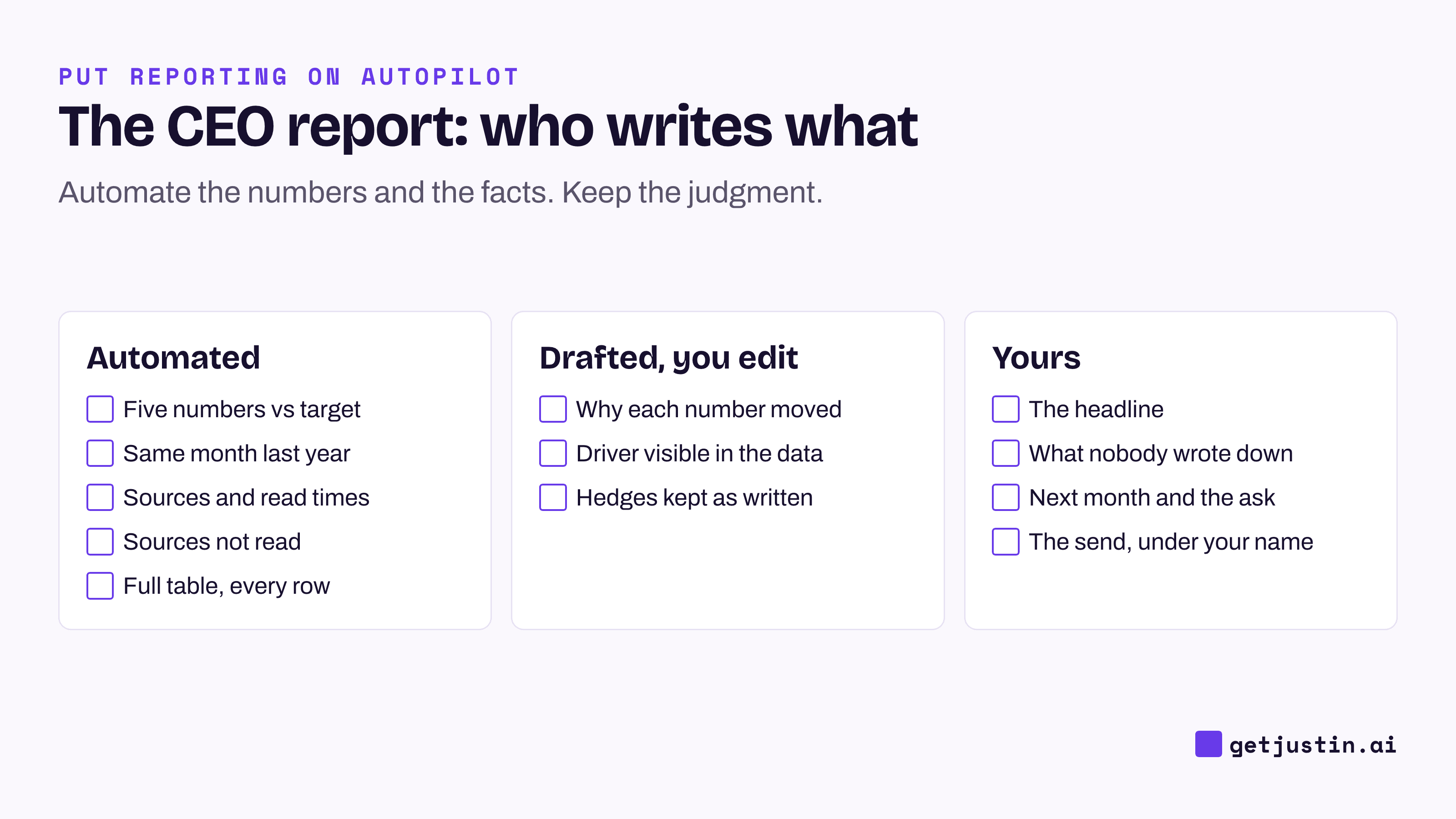
Figure: Automate the numbers and the facts; the headline, the reasons nobody wrote down and the ask stay yours.
Which five numbers belong in a CEO or board marketing report?
Pick five numbers your CEO already recognizes from the P&L or the pipeline review. Click-through rate and CPM are inputs the team watches; the CEO needs outcomes and cost.
Slot | DTC brand | B2B company | What counts as news |
|---|---|---|---|
Growth | Net revenue | New pipeline created | Off monthly target past a bar you set |
Cost | Total marketing spend | Total marketing spend | Over or under budget |
Customers | New customers | Closed-won deals from marketing-sourced pipeline | Against target, then against last year |
Efficiency | Blended CAC | Cost per opportunity | Against its target, not against last month |
Durability | Returning-customer revenue | Win rate | A three-month trend, not one month |
Write the bar for news next to each number, because each metric has its own. On our team, a naive check once flagged a new-customer return on spend below 1.0 as a problem. First-order acquisition usually runs below break-even, so that’s expected; the real alarm is blended return below 1.0. Write that rule into the report once, and the draft stops raising alarms about normal months.
Channel-level credit is the contested number, because ad platforms each claim the same sale. Keep the CEO view blended and put channel credit in the full table. For B2B pipeline numbers, see HubSpot marketing reporting from campaign to closed-won.
How do you write the “why it moved” section?
Give each number that crossed its bar one line: what moved, the driver you can see in the data, and how sure you are. An AI coworker can find the visible driver, such as a channel, campaign, product or week. It can’t know about a supplier delay or a price test unless someone wrote it down.
Example: the same brand’s August draft, and what the marketing lead added.
Number | What moved | Driver in the data (drafted) | What only you know (added) |
|---|---|---|---|
New customers | 6% under target | Meta prospecting spend down 30% after Aug 14 | Paused on purpose while the landing page was rebuilt |
Blended CAC | $52 against a $45 target | Spend flat while new customers fell | Should recover after prospecting restarts Sep 2 |
Returning revenue | Up 9% | Post-purchase email flows drove most repeat orders | The loyalty launch the CEO asked for in Q2 |
Keep the draft to facts until you trust its judgment: dated facts, each “as of” the day it was read, with the verdict left to you. A verdict label is the first thing to leave out; what should stay human on a small team explains why.
Keep the hedges, too. “Likely because” is honest when the data shows timing but not cause, and one wrong “because” makes a CEO doubt the rest.
How do you set up an automated monthly marketing report?
Automate it like a weekly report: one sentence that says when, which numbers, from where, what counts as news and where it lands. The weekly report guide covers that sentence clause by clause. A monthly CEO draft changes four things.
Timing: a few days after month-end, once refunds and late ad-platform conversions settle.
Comparisons: target and the same month last year, so a seasonal dip isn’t read as a problem.
Destination: a DM or a private drafts channel, never the CEO’s inbox.
Gaps: a failed source gets named, never filled with last month’s figure or an estimate.
Example: “On the 3rd of each month at 9am Pacific, send me a draft CEO report for last month: revenue and new customers from Shopify, spend from Meta Ads and Google Ads, blended CAC and returning-customer revenue, against target and the same month last year; one facts-only line on the driver of any number past its bar; any source you couldn’t read; and a link to the full table.”
The thread below shows that draft arriving.
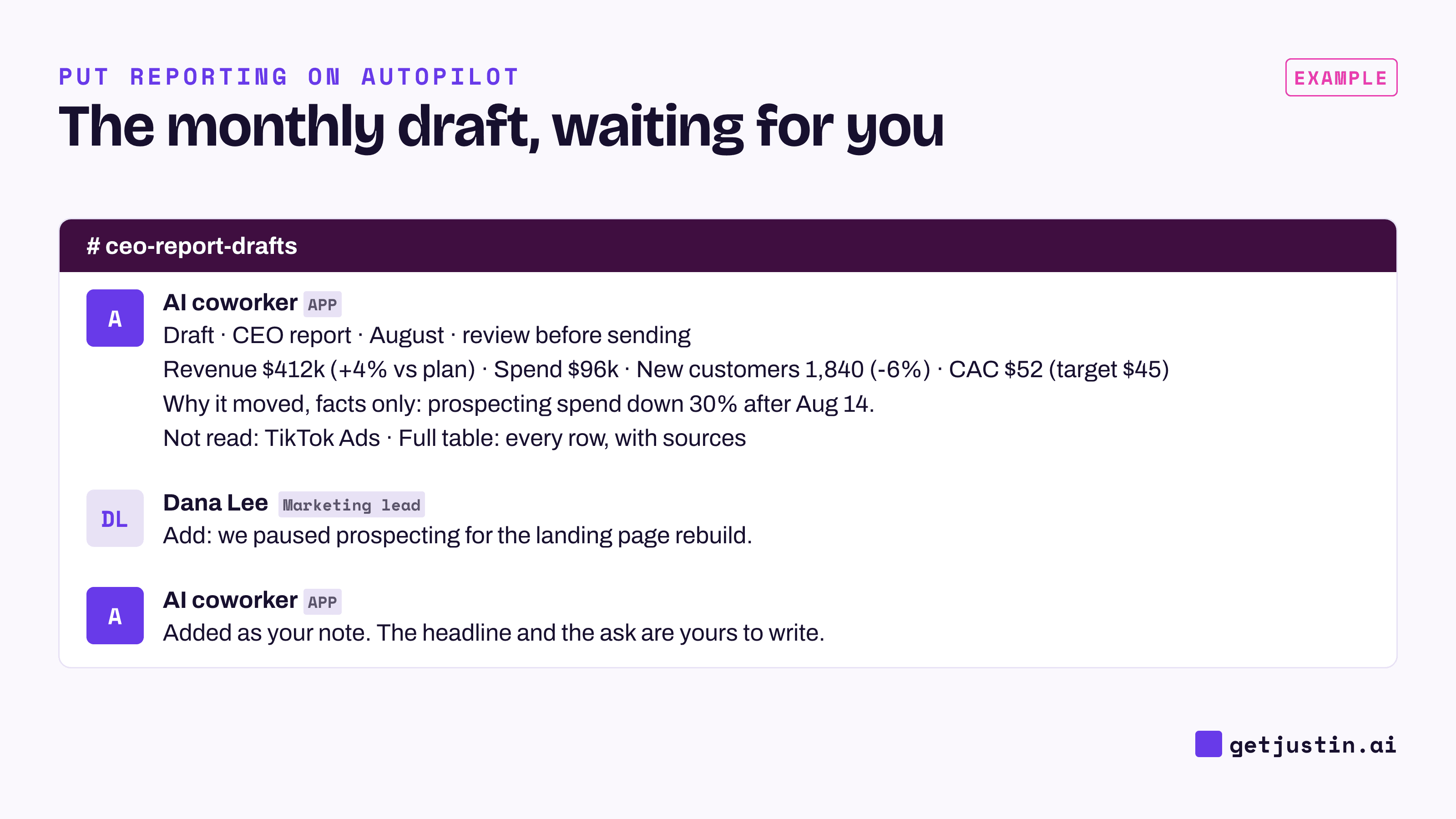
Figure: The draft arrives in a private channel, with its gaps named, and waits for you.
What should you check before it goes to the CEO?
Check the draft against the screens your CEO can open, then add what only you know.
Check | Why it matters |
|---|---|
Two numbers match each platform’s own screen | The CEO can open that dashboard too |
Every “because” comes from the data or from you | The draft knows only what was written down |
Nothing is called launched or finished on the draft’s word | Logs lag reality; a “preview” item may already be live |
The ask has an amount and a date | Without both, it reads as an update |
The sources-and-gaps line survived your edits | A missing source is news too |
The ask is the part most reports bury. When our CS ops lead wrote a leadership report about our own team’s capacity, its stated purpose was “to make the trade-off explicit so leadership chooses it deliberately rather than discovering it later.” If you need budget moved, say how much and by when.
Then send it as yourself. Our routine digests go out under the AI coworker’s name, but the analysis our CS ops lead forwards to product and engineering goes out under the lead’s own name, because it carries the lead’s judgment. A CEO report carries yours.
FAQ
How long should a monthly marketing report for a CEO be?
One screen: a headline, five numbers, a few “why it moved” lines and the ask. If the CEO has to scroll to find the decision, the report is too long.
What’s the difference between a monthly marketing report and a board marketing report?
A monthly marketing report for a CEO covers one month and asks for near-term decisions. A board marketing report is usually quarterly and shows the same five numbers across three months, so directors see the trend. Keep the definitions identical so the monthly reports become the board deck’s appendix.
Can AI write the whole monthly marketing report?
AI can pull the numbers, compare them to targets and draft the data-visible reason each one moved. It can’t know context nobody wrote down, like a paused campaign. Write the headline and the ask yourself.
What if a data source fails the month the report is due?
Send the report with the gap named, such as “Google Ads not read: connection expired.” A silent guess is worse than a visible gap. For drops that can’t wait a month, add anomaly alerts for marketing metrics or a live dashboard page in Slack.
Doing this with Justin
Justin, the AI coworker for Slack, can draft this report as a monthly automation. Connect Shopify, Google Analytics, HubSpot, Meta Ads or Google Ads once in app.getjustin.ai/connectors. In a DM, describe the report in one sentence, name the time zone, and ask Justin to read the terms back before the first run. Use Run now on last month to compare the draft with your dashboards. Ask for the full table as a live page; live pages show when their data was last updated, and you can ask where any number came from. Reply under the draft to correct a line, then send the reviewed version to your CEO yourself.