

Short answer: An AI marketing agent in Slack is an AI coworker that sits in your team’s channels, reads your marketing tools, and posts reports, answers and first drafts in the thread where you asked. For a 5-person team, its real value is the reading work: the Monday report, reconciling numbers across platforms, and the first pass at why a number moved. Anything that spends money, changes a live campaign or leaves the team waits for a person to approve it.
Many vendor pages describe an agent that runs your marketing for you. On a team of five, the version worth paying for reads what nobody has time to read, and hands the decisions back.
What does an AI marketing agent in Slack do in a week?
In a typical week, the AI coworker runs one standing job and answers the questions people used to park for later. Example: the table below is an illustrative week for Acme, a 5-person DTC brand with a founder, a growth lead, a content lead, an email marketer and a designer.
Day | Who asked | What the AI coworker did | Needed a person? |
|---|---|---|---|
Mon 8:00 | Nobody; it’s scheduled | Posted the weekly report: five numbers, conclusion first, sources with read times | No |
Mon 10:20 | Growth lead, in the report’s thread | Broke the dip in new customers down by channel and day | No |
Tue | Content lead | Listed last month’s best-converting landing pages from GA4 | No |
Wed | Founder | Put Shopify and GA4 revenue side by side and named the one the report uses | No |
Thu | Nobody; spend crossed its pacing bar | Flagged Meta spend ahead of the monthly plan; drafted a lower daily budget | Yes: the budget change |
Fri | Email marketer | Drafted Monday’s customer email from the week’s best sellers | Yes: the send |
Four of the six jobs only read. The two that act stopped and waited for a yes, and that split is what we’d aim for on a small team.
The two unprompted rows behave differently. The Monday report posts every week, even with one line to say, because a missing report looks like a broken one. Ad budget pacing alerts are the opposite: silent on a normal day.
Which jobs should a small team hand over first?
Hand over first the jobs that are frequent, read-only and checkable against a screen you already trust. The weekly report is the obvious one: it repeats, it changes nothing, and every figure has a platform dashboard to check against. Automating the weekly marketing report covers the one-sentence setup.
Pick the specific job, not the category. From building AI skills for our customer success team, our CS ops lead’s rule is: “The general one sounds better in a Slack message; the specific one gets re-invoked.” “Help with analytics” gets tried once. “Every Monday, put Shopify and GA4 revenue side by side” gets used every week.
The four jobs we’d start with, in order:
The weekly report. One post, five numbers, every Monday.
Reconciling platforms. Shopify, GA4 and the ad platforms rarely agree, so have it label the figure you report; see GA4, Shopify and Meta in one Slack thread.
The first “why did it move”. A channel, campaign and day breakdown for any number that crossed its bar. It narrows the search; a person still names the cause.
Research pulls for briefs. Top pages, top products, last quarter’s best subject lines.
Check the first two runs of each against the platform’s own screen. The diagram below sorts the usual jobs into three piles; the middle one is what most vendor pages skip.
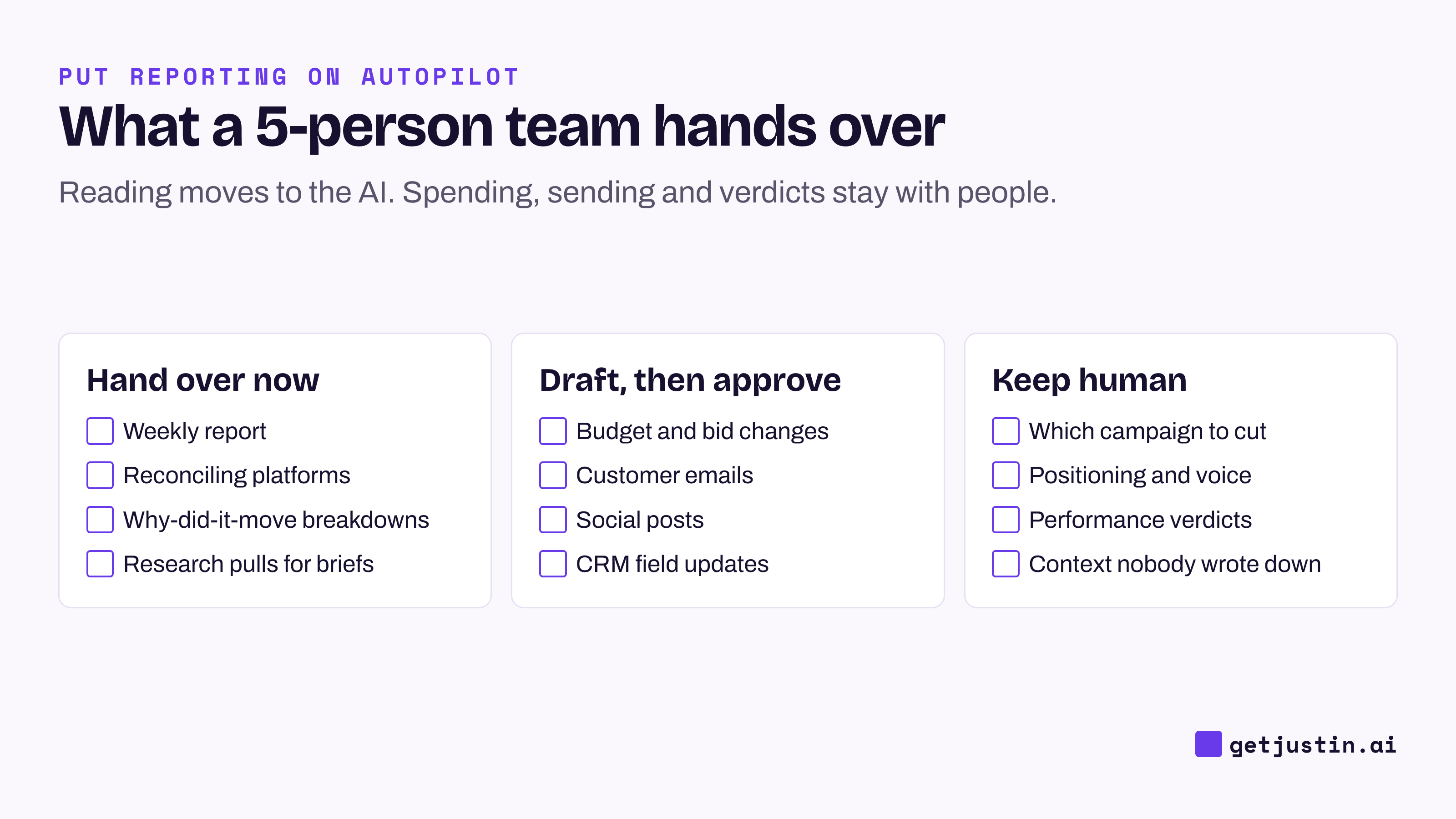
Figure: Reading moves to the AI coworker; spending, sending and verdicts stay with a person.
What should stay human on a small marketing team?
Anything that spends money, reaches a customer or states a verdict should stay with a person. Spending and sending are the obvious cases: a budget change, a paused ad set, an email to your list. The AI coworker drafts them, and a named person approves.
Verdicts are the less obvious case. On our CS team, a daily scan once rated a struggling account “Healthy” because its latest thread was about setting up a weekly call. The real signal was the run of declined meetings before it. We stopped tuning the label and took it out: the notes now state dated facts, and people draw the conclusion.
The marketing version is a report that calls a campaign “underperforming”. A prospecting campaign with a weak return may be doing exactly what you bought it for. Have the report state each number against its own bar and leave the verdict to the growth lead; the AI marketing analyst that asks before it writes covers the approval side.
What does an AI coworker cost a 5-person team?
The subscription is the smaller cost; the owner’s attention is the larger one. On price, check whether you pay per seat or per team, and whether scheduled jobs sit on the entry plan. A per-seat price multiplies by five; a team price with pooled usage doesn’t.
Setup is short if the tools are ready: one person authorizes GA4, Shopify and the ad accounts, and the first job is one sentence. Then budget two weeks of side-by-side checks, as the diagram below shows.
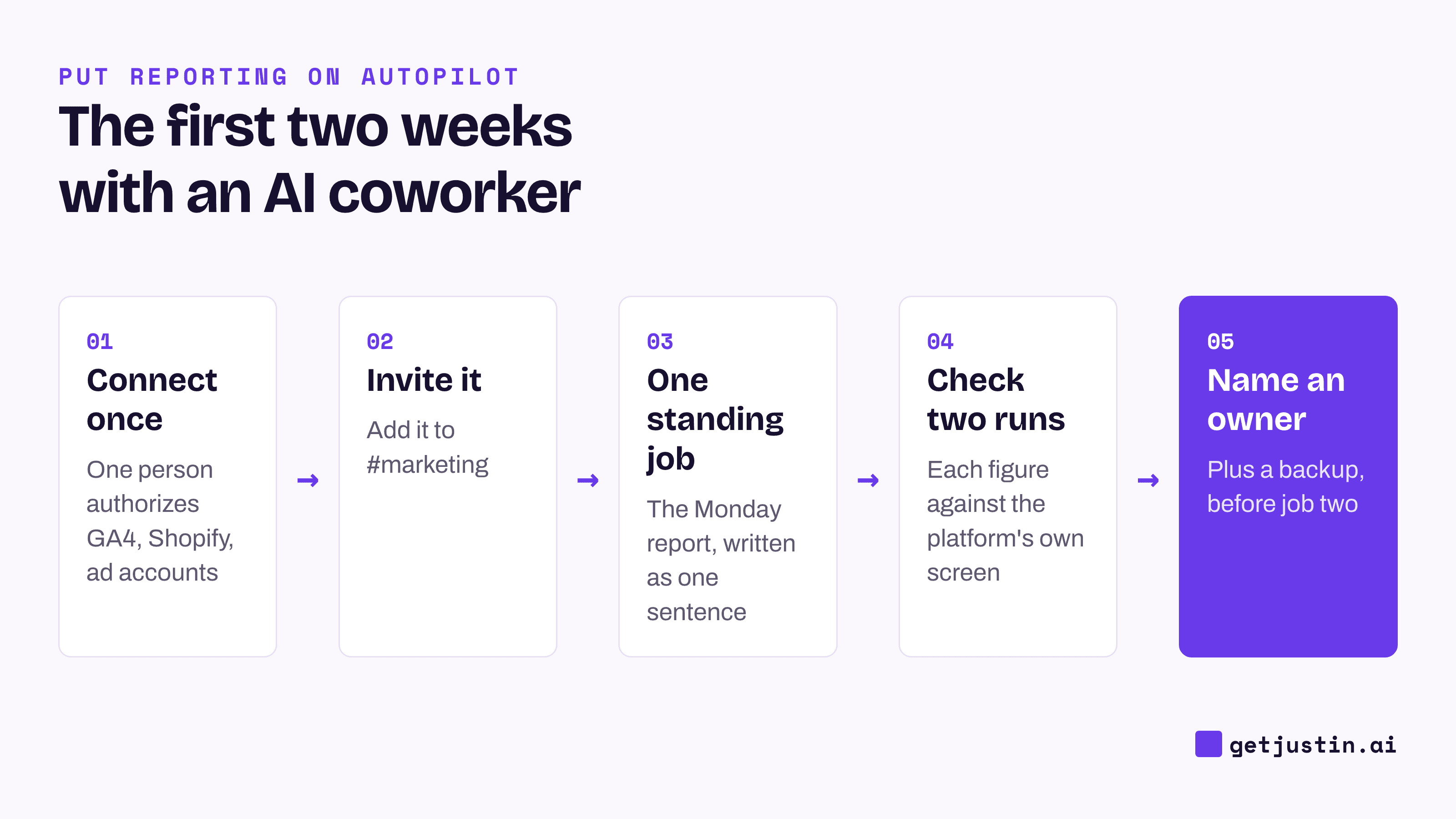
Figure: One job, checked twice and owned by a named person, before the second job starts.
The cost nobody prices is ownership. When our CS ops lead measured our own setup for leadership, the automation layer ran roughly twelve unattended runs for every hands-on session in July. The same report named the risk: “the predictable failure mode is the automation layer, because it degrades quietly and nobody notices for weeks.” On a team of five, that means one owner and one backup for every standing job, written down next to the job.
FAQ
Is an AI marketing agent in Slack the same as marketing automation software?
No. Marketing automation software runs sequences you designed in advance, such as a welcome series or a lead-scoring rule. An AI coworker in Slack answers questions in plain language, runs standing jobs like a weekly report, and drafts changes for a person to approve. Many small teams use both; AI agent vs Zapier covers where each fits.
Can an AI marketing assistant for small teams post to social or send emails on its own?
It shouldn’t, and a well-built one won’t by default. Posting and sending reach customers, so the AI coworker should draft the message and ask for approval in the channel. A standing approval for one narrow action, such as a recurring internal digest, is a reasonable exception.
Do we need a data analyst to run it?
Not to start. Someone has to know what each number should be, which on a small team is usually the growth lead. That person checks the first runs and owns the job afterwards.
Will an AI coworker replace a marketing hire?
On a team of five, it takes over reading and copying, not a role. It can’t set positioning, choose which campaign to cut, or know about the influencer post that went out on Saturday. Plan it as the team’s reader, and keep hiring for judgment.
Doing this with Justin
Justin, the AI coworker for Slack, covers this week without seats: every plan includes the whole team, with credits pooled across it. Connect Google Analytics, Shopify and HubSpot once in app.getjustin.ai/connectors; one person’s connection works for everyone by default. Invite Justin to #marketing and @-mention it with a question, or DM it. Ask for the Monday report in one sentence, naming your time zone, and ask Justin to read the terms back before the automation starts; the pricing page lists scheduled tasks on Pro and Max. It asks before it writes to your connected tools, such as a budget change in an ad account, and approvals are recorded.