

Short answer: An AI marketing analyst is an AI coworker that reads your marketing data, answers questions about it and drafts the analysis a person would otherwise write. A good one asks twice: what you mean before it answers, and for approval before it writes to a live system. Every number it gives should name its source, and every answer should say what the data couldn’t tell it.
Most tools sold this way compete on speed. Speed is the easy part; the analyst we’d trust with a Monday decision is the one that stops to ask.
What does an AI marketing analyst actually do?
An AI analyst does what a human one does: pull the right number, explain why it moved, and say what the data can’t show. The AI coworker is fast at the first two and weak at the third, unless you make the limits part of the job.
Analyst task | Where the AI helps | Where it misleads | The check |
|---|---|---|---|
Pull a figure | Reads several tools at once | Builds its own version of a platform’s metric | Match two figures to the platform |
Explain a move | Splits it by channel, campaign and day | Names a cause the data doesn’t support | Ask what else explains it |
Summarize text | Groups reviews and call notes into themes | Turns a rep’s narration into a customer’s words | Read five raw examples per theme |
State the limits | Lists what it read, if asked | Fills a gap with a guess | Require a “not checked” line |
Recommend an action | Drafts options with the numbers | Treats an approved plan as permission | Approve the write separately |
The last two rows are where the AI differs most from a person: a junior analyst who isn’t sure asks, and the AI usually doesn’t.
Where does an AI analyst for marketing mislead?
An AI analyst for marketing misleads most when its answer is internally consistent and still wrong. On our CS team, we built an audit of the conversions a client’s dashboard reports. We worked out one filter ourselves instead of looking up how the platform defined it. Every figure came out 3–4% high, and every internal check passed, because the checks shared the same mistake.
Only comparing two figures with the client’s own screen caught it. Our rule since: assert only what the client could reproduce in their own dashboard. Checking a weekly report against each platform shows how.
Most people skip that check. In a global survey, 66% of respondents said they rely on AI output without evaluating its accuracy (KPMG and University of Melbourne, 2025). So the AI coworker has to make checking cheap: a source and read time beside every figure, and a hedge where the data is thin. We’ll take a hedged, correct answer over a crisp, wrong one every time.
Why should an AI coworker ask before it answers?
An AI coworker should ask first because a vague question otherwise gets a confident guess. The habit our CS ops lead pushes hardest when teaching the CS team starts from one observation: “The AI never says ‘I’m not sure what you mean.’” It fills the gap, and you only see the guess in the finished answer.
“How did the spring campaign do?” hides three decisions: which campaigns count, compared with what, and which revenue figure. A good analyst settles them before pulling anything, as below.
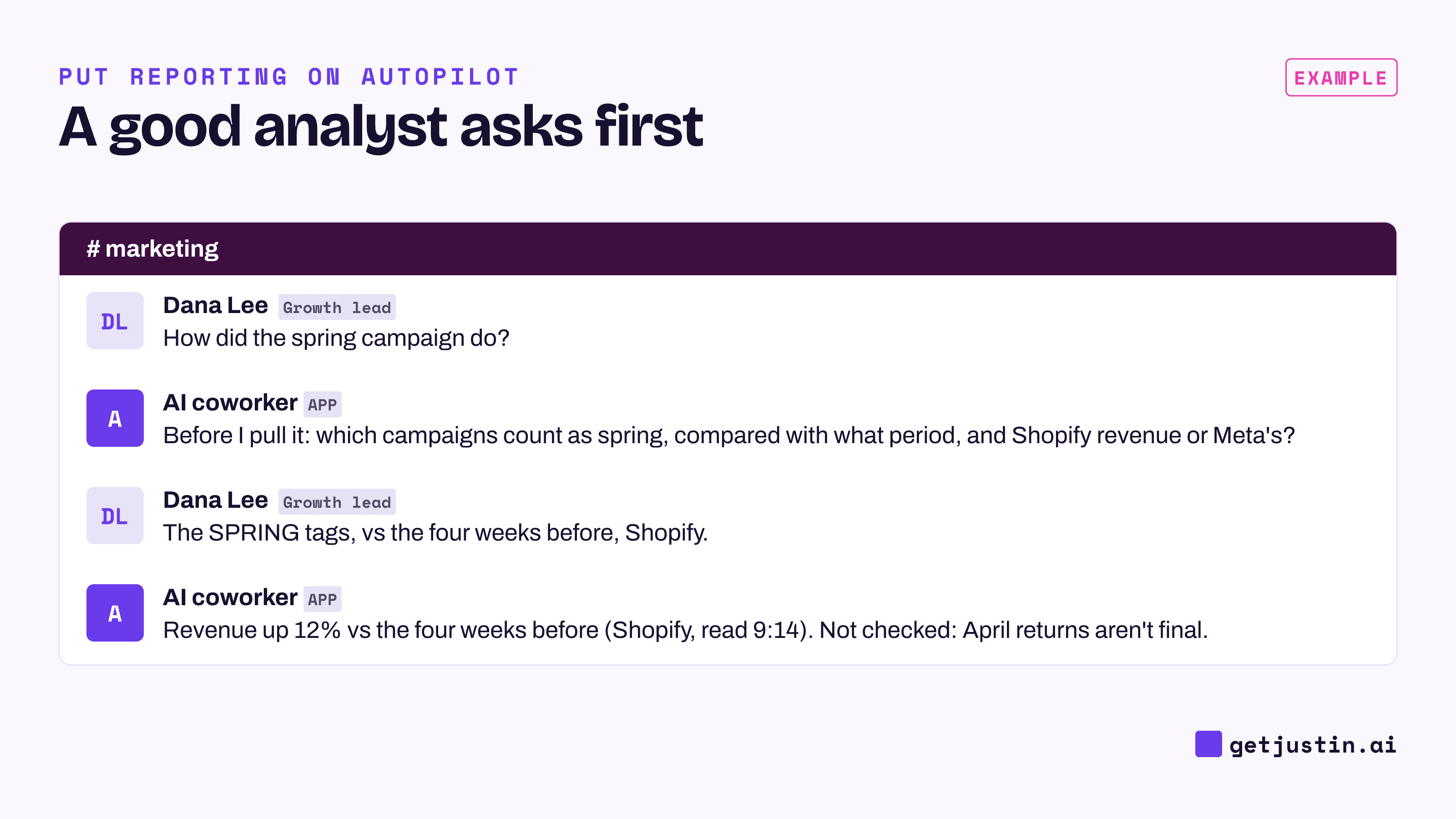
Figure: Three questions up front turn a guess into an answer you can check.
The same rule covers missing values. On one of our scheduled jobs, we blanked a single field as a test, and the forecast downstream silently read the empty value as 0%, filing the account as a lost cause. A guessed 50% default fails the same way in the other direction. The job’s notes now say: “Surfacing the gap to a human beats guessing either way.” A missing week of ad data should come back as “not available”, never as a zero.
Why should an AI coworker ask before it writes to a live system?
An AI coworker should treat every write as its own decision, because approving a plan is not approval to write. Our CS ops lead learned this building a skill that sets up grouping rules inside client accounts. The ops lead picked three live accounts to test on and answered the design questions, and the AI read those answers as permission to write.
It wasn’t, and those rules can’t be reordered once created, so an early write means deleting and rebuilding. The ops lead’s correction became the standing rule: “Approving a plan is not approval to write it.” On our team, the skill was then validated on nine accounts, all as dry runs, with nothing written.
Where the approval happens matters too. We once built a separate approval bot, with preview cards and a reaction watcher, then tore it out. Approval now happens in the conversation where the work ran: a numbered list, answered with “approve all” or “approve #1 #3”. More machinery hadn’t made it safer. The model has five steps: read without approval, draft the change, ask for it as a write, approve per item, then write and record who approved. An AI usage policy for agents that take action turns it into team rules.
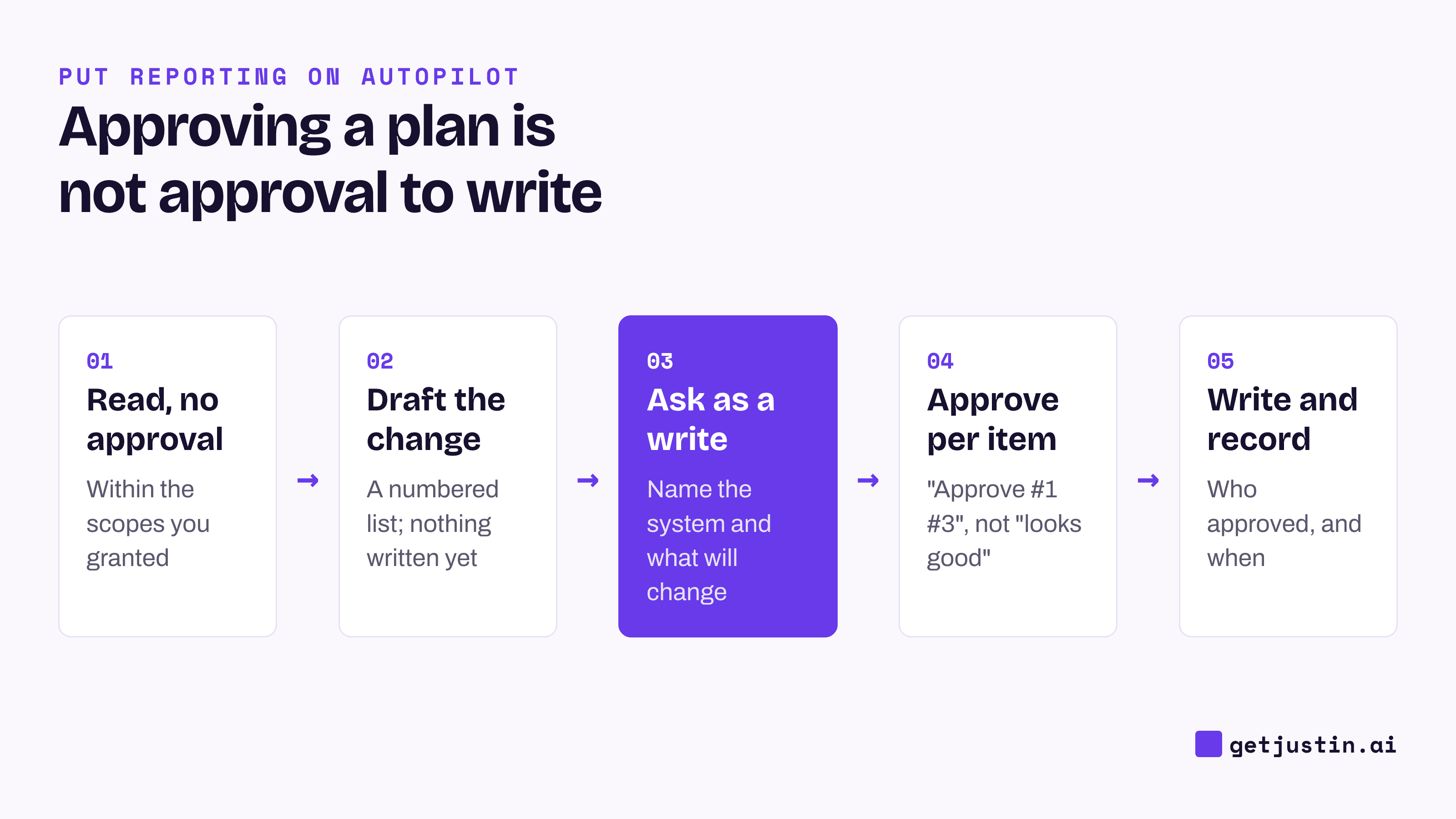
Figure: The plan and the write are two separate yeses.
How do you test an AI coworker’s analysis in a trial?
Test it in your own trial, with questions you already know the answers to. Each of these five tests comes from a failure we’ve seen:
Ask something vague. “How did last month go?” It should ask what you mean first.
Ask for a number you know. It should match the platform’s screen and name its source and read time.
Ask about a gap. Pick a week a source was disconnected. It should say “not available”, not zero.
Approve a plan, then watch. Does it write, or ask again with the write spelled out?
Correct it once. Fix a definition today and ask again next week. The correction should stick; how AI memory works at work explains why some tools forget.
If a tool fails test 4, keep it read-only.
FAQ
Can an AI marketing analyst replace a human analyst?
It can take over much of the pulling and first drafts, not the judgment. Someone still has to know what a number should be and own the call. On a small team that person is often the growth lead; see what an AI marketing agent in Slack does for a 5-person team.
What data should an AI data analyst for marketing see?
Start with read access to the platforms you report from: analytics, store, ad accounts and CRM. Have it take each finished metric as the platform defines it, rather than rebuilding it from raw rows. Grant writes one action at a time, behind an approval.
How do I know whether an AI analyst’s numbers are right?
Compare two figures per source against the platform’s own screen for the first two weeks. If they differ, the AI is using a different definition or filter. If every figure is off by the same small percentage, suspect a filter such as the date range or time zone.
Why does an AI analyst give different answers to the same question?
Usually the question left something open, such as the date range, the time zone or which revenue figure to use. Pin those in the question, or ask the AI to list its assumptions before it answers.
Doing this with Justin
Justin, the AI coworker for Slack, asks before it writes to your connected tools. Reading doesn’t need approval, so it answers from those tools straight away, and its live pages show when their data was last updated; ask where any number came from. Ask it to list its assumptions before it answers. When a job reaches a write, it asks first: approve just that action, or that kind of action from then on, and every approval records who gave it and when. Ask it to remember a correction, such as how you define a metric, and it keeps it for the team. Justin uses large language models, and its output can be wrong or incomplete, so check anything consequential before you act on it.
Related reading
Automate your weekly marketing report in Slack, in one sentence
What an AI marketing agent in Slack does for a 5-person team
An AI usage policy for agents that take action (template)