

Short answer: A brand growth strategy for small teams rests on three choices and one weekly habit: the few buying moments you want to be remembered for, the two channels you will show up in every week, and the assets you repeat until people recognize them. Without an agency, an AI coworker can carry the research, first drafts and reporting, while the team keeps positioning, taste and every public send.
Most advice for small brands is twenty tactics that three people can’t run at once. A small team is short on attention, not ideas, so this playbook is mostly about what to stop doing and who does what.
What does an agency do that a small team has to replace?
An agency sells six things, and only a few are hard to replace. List what you would actually be paying for before deciding you need one.
Agency job | Without an agency | Who does it |
|---|---|---|
Market and competitor research | A short brief before each decision, refreshed weekly | AI coworker gathers and counts; you check what you’ll act on |
Positioning and messaging | One sentence you can defend, reviewed each quarter | The team. A model can’t decide what you stand for |
Content and creative production | Drafts on a schedule, edited by a person | AI coworker drafts copy and variants; a person edits and approves |
Media planning and buying | Two channels, small tests, one weekly review | The team, with the AI pulling the numbers |
Reporting | One weekly note, conclusion first | AI coworker, on a schedule |
An outside opinion | A standing “argue against this” request, plus a peer you trust | Partly AI, mostly a person outside the team |
Small teams miss the last row most, because an agency’s most useful meeting is often the one where someone calls the idea weak. Ask the AI to argue against your plan, but don’t mistake a fluent objection for an informed one.
A brand growth strategy for small teams: three choices
A small team grows a brand by choosing narrowly and then repeating itself. Three choices do most of the work.
1. The buying moments you want to own. Researchers at the Ehrenberg-Bass Institute call these category entry points: the thoughts buyers have as they move toward a purchase, such as “a gift under $50” or “shoes for standing all day”. A small brand should pick three to five and show up for them everywhere. Reviews and support tickets are the cheapest place to find them; AI customer review analysis covers the method.
2. Two channels and a cadence you can keep for six months. One channel you own (email, a blog) and one for reach (a social platform or paid search) is plenty for three people. Choose the cadence you could hold in your worst month. If the owned channel is a blog, the AI SEO workflow covers drafting.
3. Assets you repeat until you are bored of them. A line, a color, a photo style. Customers start noticing a brand long after the team has tired of it, so boredom is the wrong signal to change course.
Example: Acme, a 12-person DTC brand, picks “a gift for a new parent” and “a present that arrives in two days”, runs a weekly email plus Instagram, and opens every post with the same product-in-hand photo.
The weekly brand loop
Brand growth on a small team works as a loop, not a campaign. A campaign needs a burst of production that an agency absorbs; a loop needs a steady week. The diagram below shows who carries each step.
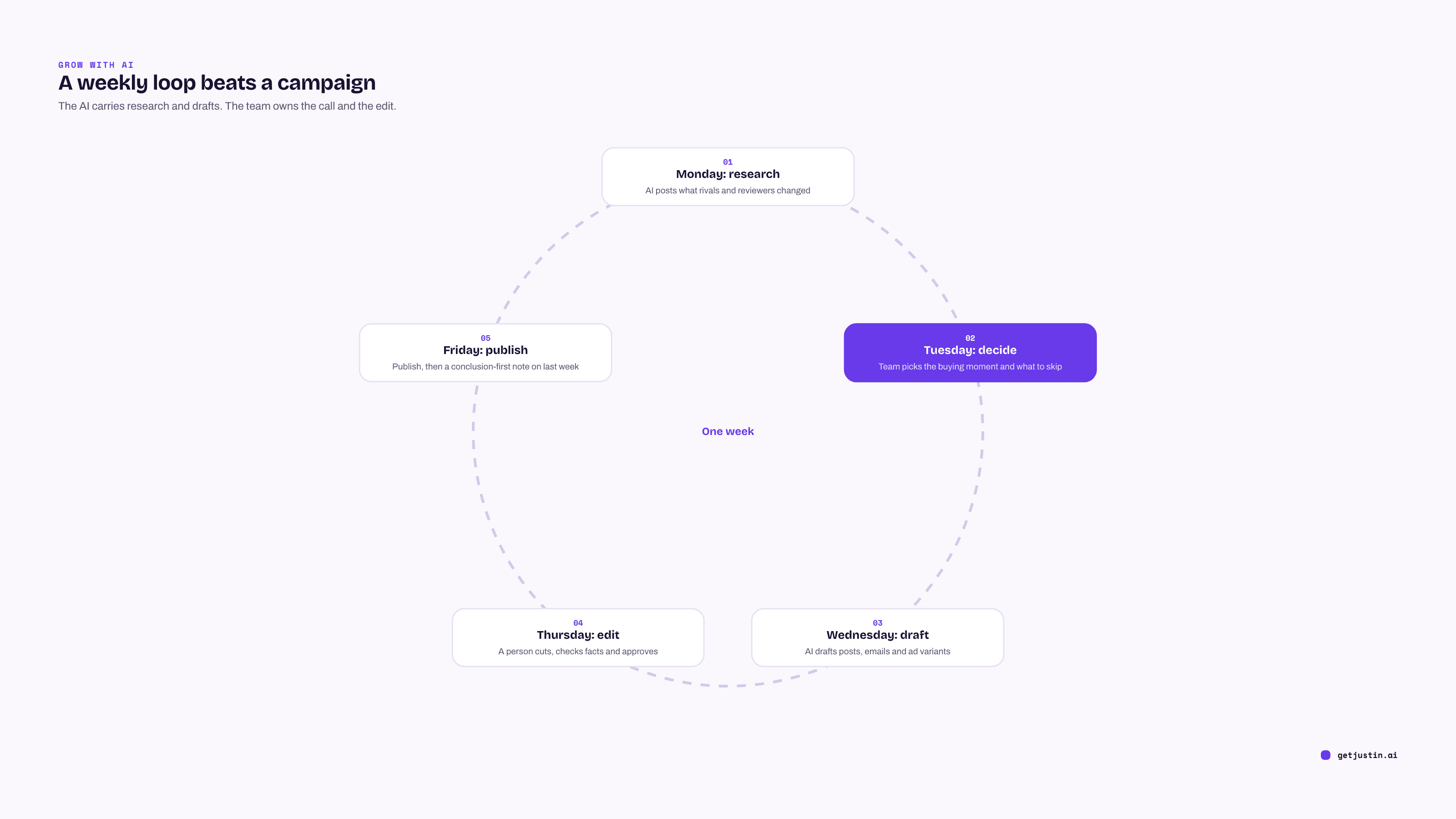
Figure: The AI coworker does the reading and drafting, so the team’s hours go to the decision and the edit.
Monday, research. The AI coworker posts what competitors shipped, which ads are new and what reviewers said. The one-afternoon competitor research plan is the full version; Monday’s brief is only what changed.
Tuesday, decide. Twenty minutes as a team: which buying moment this week’s work serves, and what you are skipping.
Wednesday, draft. The AI drafts posts, emails and ad variants from your past winners.
Thursday, edit. A person cuts, checks every product claim and approves.
Friday, publish and review. Publish, then read one conclusion-first note on last week (how to automate the weekly marketing report).
On our CS team, every scheduled job that drafts something runs in review mode. The weekly product announcement arrives marked “review before sharing”, and nothing publishes itself. Run a brand loop the same way: the AI drafts every word, and a person presses publish.
What should the AI coworker do, and what should the team keep?
The split follows two questions: how often does the task come up, and how much does it depend on taste? Frequent, mechanical work goes first; rare, taste-heavy work stays with you.
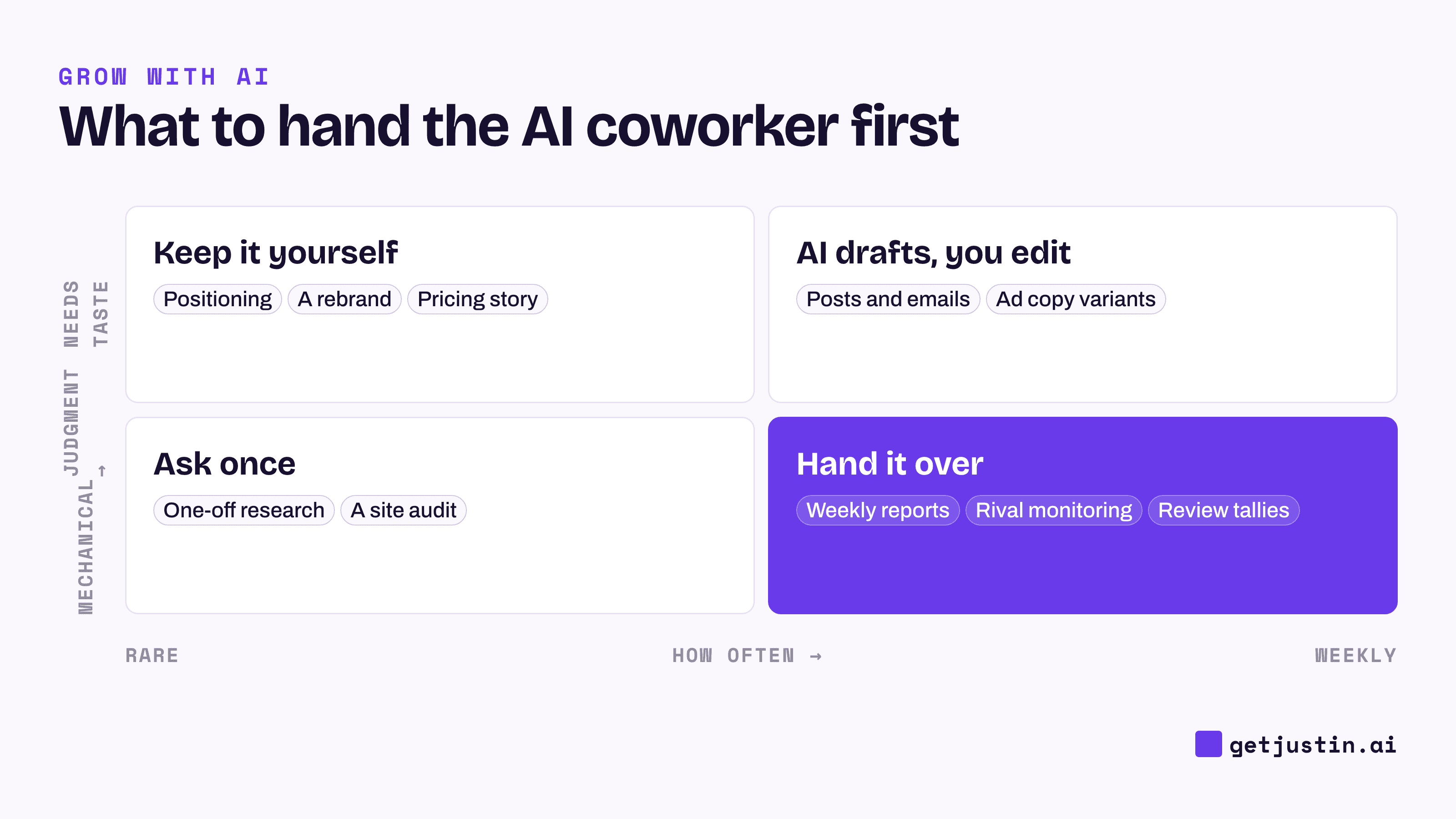
Figure: Hand over the weekly, mechanical work first; keep positioning and the final edit.
Most of the AI coworker skills a marketing team should build first sit in the “hand it over” corner: weekly recaps, competitor ad watches and review digests.
Two cautions. Brand voice drifts when nobody reads drafts closely, so keep a list of words your brand never uses and check every draft against it. Our CS ops lead calls that list “the cheapest QA gate you’ll ever write”, and the AI SEO workflow shows how the one on our CS team grew. And the AI will state confident claims about your product if you let it, so give it the facts it may use.
Measure the load before you add a channel
An AI coworker adds real capacity, and it hides how much is running. Every scheduled brief, draft and report is a small job someone has to own when it breaks.
When our CS ops lead was asked to take on positioning and paid promotion for a self-serve product, on top of existing work, the ops lead measured before saying yes. The logs showed the automation layer carrying the load: in July, roughly twelve unattended runs for every session run by hand. They also showed the risk. None of those routines had a backup owner, and the likeliest failure was a quiet one, a job that degrades while nobody notices for weeks. The ops lead wrote the report “to make the trade-off explicit so leadership chooses it deliberately rather than discovering it later.”
Before adding a third channel, list every automation you run, name an owner and a backup for each, and decide which one you would switch off first.
When should a small team hire an agency anyway?
Hiring an agency still makes sense in four situations.
Paid media at a scale where expertise pays for itself. Run small tests yourself first, so you know what good looks like.
Production craft you can’t fake: a video shoot, packaging, a new visual identity.
A positioning reset, where the outside view is the thing you are buying.
Nobody owns the loop. If no one has time for Tuesday’s decision and Thursday’s edit, an AI coworker will only produce drafts nobody reads.
FAQ
How can a small business grow brand awareness without an agency?
Pick three to five buying moments to be known for, two channels you can sustain every week, and a few assets you repeat. Use an AI coworker for research, drafts and weekly reporting, and keep positioning and publishing with a person. Months of consistency do more than one big campaign.
What should a brand growth playbook include?
The buying moments you are targeting, your channels and cadence, the assets you repeat, a weekly loop with an owner for each step, and the few signals you review. It should also list what you are not doing this quarter, so the team has permission to say no.
Can AI replace a marketing agency?
AI can take over much of the research, first drafts and reporting an agency does. It doesn’t replace positioning judgment, production craft or a trusted outside opinion. Treat it as extra capacity for your team, not a substitute for deciding what the brand stands for.
How do you track brand growth on a small team?
Watch a few slow signals instead of one precise number: branded searches in Google Search Console, direct visits, newsletter sign-ups, and whether reviews start naming the buying moments you chose. Review them monthly, because brand signals move slowly and a single week says little.
Doing this with Justin
Justin, the AI coworker for Slack, can run the research and drafting half of the loop in the channel your team already uses. Invite it to #brand and ask for an automation in plain language, such as “every Monday at 9am New York time, post a brief from our review sheet and last week’s Google Analytics.” Name your own time zone, and ask Justin to read the schedule and destination back before it sets it up. Point it at a rival’s pricing page or changelog, share ad screenshots as files, and ask for drafts in your voice. Ask it to remember a correction, and it keeps it for the team. It asks before it writes to your connected tools, like scheduling a Mailchimp campaign; approve once, or for that kind of action.