

Short answer: ChatGPT names the brands that other sources describe clearly and consistently, so getting mentioned is mostly about what the web says about you, plus your own pages answering buyer questions plainly. Start by asking ChatGPT the 20 questions your buyers ask and logging who it names. Then let its search crawler in, publish direct answers, make your claims match everywhere, earn mentions on the pages it cites, and re-run the same questions every month.
The work has a name, answer engine optimization for brands, and it differs from SEO in one way that matters: the unit is a mention inside one answer, not a position in a list of links. This guide covers that work: getting named, and described correctly, inside answers. The keyword-to-published-post workflow belongs to SEO with an AI coworker.
How does ChatGPT decide which brands to mention?
ChatGPT draws on two sources: what the model learned in training, and what it finds when it searches the web during a conversation. The training route moves slowly and you can’t steer it directly. The search route reads pages today, cites them, and is where a marketing team can make a difference this quarter.
What gets cited is mostly practical content. In one analysis of about 68,000 AI citations across six engines, how-to and explainer guides were about a third, brands’ own product pages about a fifth, and ranked lists about a fifth (Fractl, 2026). Original research was cited 0.6% of the time. The engines quote pages that answer a question, not pages that announce something.
The diagram below shows the loop, which starts and ends with the same measurement.
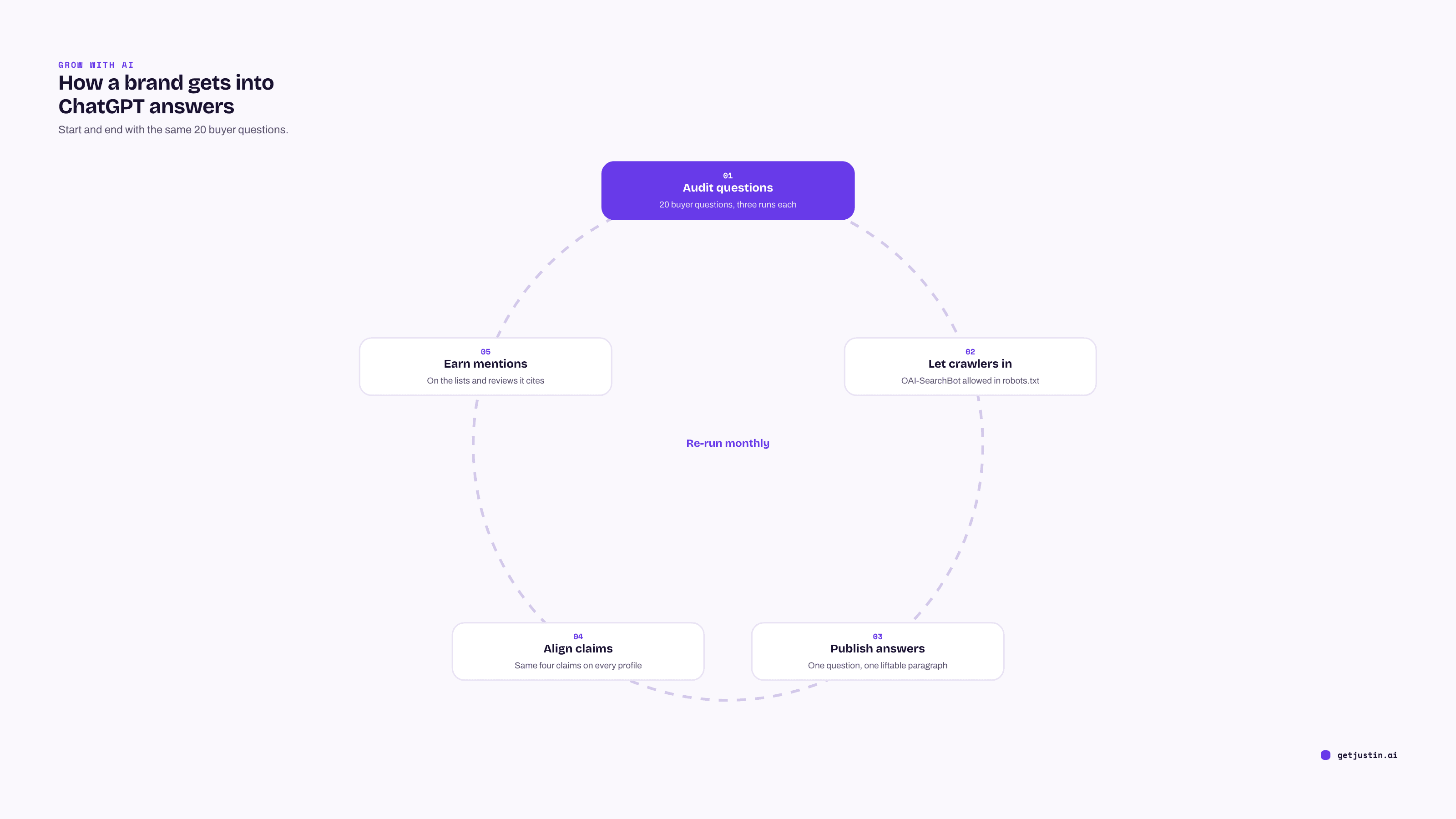
Figure: Measure first, change one thing at a time, and re-run the same questions monthly.
Step 1: measure your AI search visibility before you change anything
AI search visibility starts with an audit you can run in an afternoon. Write down the 20 questions a buyer asks before choosing a product like yours, such as “best project tool for a 10-person agency”, not your brand name. Ask each one in a temporary chat or a logged-out window, so your own history doesn’t shape the answer, and ask it three times. Answers vary from run to run, and a single run tells you very little.
Question | Run | Brands named, in order | Named us? | What it said about us | Sources cited |
|---|---|---|---|---|---|
Example: best CRM for a 10-person agency | 1 | Rival A, Rival B, Rival C | No | n/a | A review site, a ranked list, Rival A’s pricing page |
Example: best CRM for a 10-person agency | 2 | Rival B, us, Rival A | Yes | “Good for small teams, limited reporting” | A forum thread, our pricing page |
Count questions, not mentions. “Named in 7 of 20 questions” is a number you can move. Twelve mentions in one question is one question. The “What it said about us” column matters as much as the tally, because a wrong description is worse than no mention.
Step 2: let the search crawler in
ChatGPT can only cite pages its search crawler is allowed to read. OpenAI runs separate crawlers for search and for training: OAI-SearchBot surfaces sites in ChatGPT’s search answers, and GPTBot collects content that may be used to train models. You can allow one and block the other.
Check three things in robots.txt and your firewall settings:
OAI-SearchBot is not blocked, including by a CDN or bot-protection rule set up by someone else.
GPTBot is set the way your company actually decided, not by accident.
Pricing, product and comparison pages load their key text without a login or a script wall.
OpenAI says a robots.txt change for its search crawler takes effect in about 24 hours.
Step 3: publish answers a machine can lift
A page gets quoted when one paragraph answers one question on its own. Open each important page with the direct answer, name the product and category again instead of writing “it”, and keep one name per concept across the site.
Write those three rules into your own style guide, because AI engines quote paragraphs, not pages.
Write each answer as if it will be pasted to a buyer without you in the room. On our CS team, AI-drafted FAQ answers get pasted to clients verbatim, so the drafts keep the expert’s own hedges and state only what the expert committed to. Hedged and correct beats crisp and wrong. An honest limit (“no mobile app yet”) is quotable; a vague superlative isn’t.
Step 4: say the same thing about your brand everywhere
AI engines repeat what most sources agree on, so a brand described five different ways gets described vaguely. On our CS team, a study of client questions found the same problem inside the company: the gap was inconsistent answers, not missing ones. The fix is consistency, not more pages, and the same holds for your brand in public.
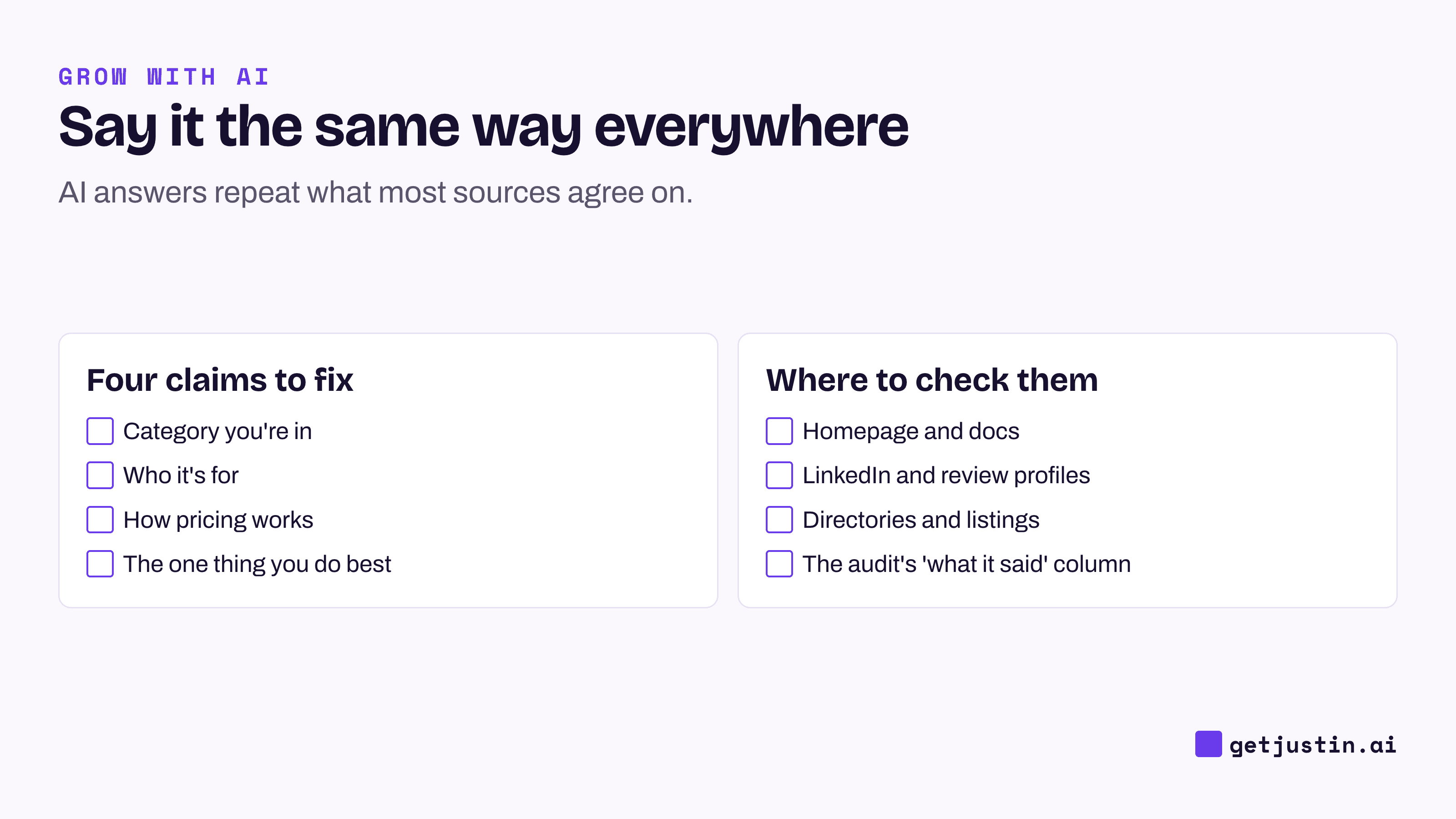
Figure: Pick four claims, write them once, and make every profile say them the same way.
Compare your homepage, docs, LinkedIn page, review-site profiles and any directory listings against the audit’s “What it said about us” column. Wherever ChatGPT’s description is wrong, one of those sources usually says it.
Step 5: earn mentions on the pages ChatGPT already cites
The “Sources cited” column is your target list. If the same ranked list, review site or forum thread keeps appearing under your buyers’ questions, that page shapes the answer more than your homepage does.
Ranked lists. Ask the author to review your product, with a trial and plain facts, not a paid placement.
Review sites. Ask real customers for reviews on the site that gets cited, not the one that’s easiest. AI customer review analysis shows what reviewers already say.
Forums and communities. Answer questions under your own name and say where you work.
Your comparison pages. Say plainly where a rival is the better choice. Honest comparisons are easier to quote; one-sided ones read as ads.
FAQ
How long does it take to get mentioned in ChatGPT?
Changes that work through search can show up within weeks once pages are crawled and cited elsewhere. Changes to what the model learned in training wait for new models, which can take months. Nobody publishes a reliable timeline, so re-run the same audit monthly and judge by the trend.
Can you pay to get your brand mentioned in ChatGPT answers?
No. ChatGPT ads are separate, labeled cards below the answer, and OpenAI says ads don’t change what ChatGPT answers. What marketers should research before buying ChatGPT ads covers the paid side.
What is answer engine optimization for brands?
Answer engine optimization is the work of making your brand appear, accurately, inside answers from AI tools such as ChatGPT, Perplexity and Google’s AI Overviews. It overlaps with SEO but measures mentions and descriptions inside answers, not rankings.
Does blocking GPTBot remove you from ChatGPT answers?
Not from search answers, according to OpenAI’s crawler documentation. GPTBot controls whether content may be used for training; OAI-SearchBot controls whether pages appear in ChatGPT’s search results. Block the search crawler and your pages drop out of those results.
Are AI visibility tools worth paying for?
They save time once you track many questions across several engines. They sample prompts too, so their share-of-voice figures are estimates; label them that way. Run your own 20-question audit first, so you know what the tool should be measuring.
Doing this with Justin
Justin, the AI coworker for Slack, can keep the audit counted in the channel your team already uses. Keep the audit table in Google Sheets, connect it, invite Justin to #growth, and @-mention it to tally, per question, which brands were named, how often you were, and which sources keep appearing. Ask for the result as a live page: it shows when its data was last updated, you can ask where any number came from, and the link stays the same each month. Then set an automation for the first Monday of each month that re-counts the updated sheet and posts what changed. Justin uses large language models; its output can be wrong or incomplete — check anything consequential before you act on it.