

Short answer: ChatGPT ads are sponsored cards that OpenAI shows below ChatGPT’s answers to people on its Free and Go plans, matched to the conversation rather than to keywords. As of September 2026, US businesses can buy them self-serve, and ads run in the US and dozens of other markets. Before spending, research five things: whether your buyers see ads at all, whether your category is allowed, what the answer above your ad says, how you’ll measure, and what a test must show to continue.
This guide to ChatGPT ads for marketers is dated on purpose. The product has changed almost monthly since OpenAI announced it in January 2026, so check each fact below on OpenAI’s own pages before you commit budget.
What are ChatGPT ads, and how do they work?
ChatGPT ads are labeled cards that appear under a relevant answer, and the answer itself is not for sale. OpenAI says ads run on separate systems and don’t change what ChatGPT answers, and that advertisers get aggregated results, never the chats. The diagram below shows which parts of the screen you can buy.
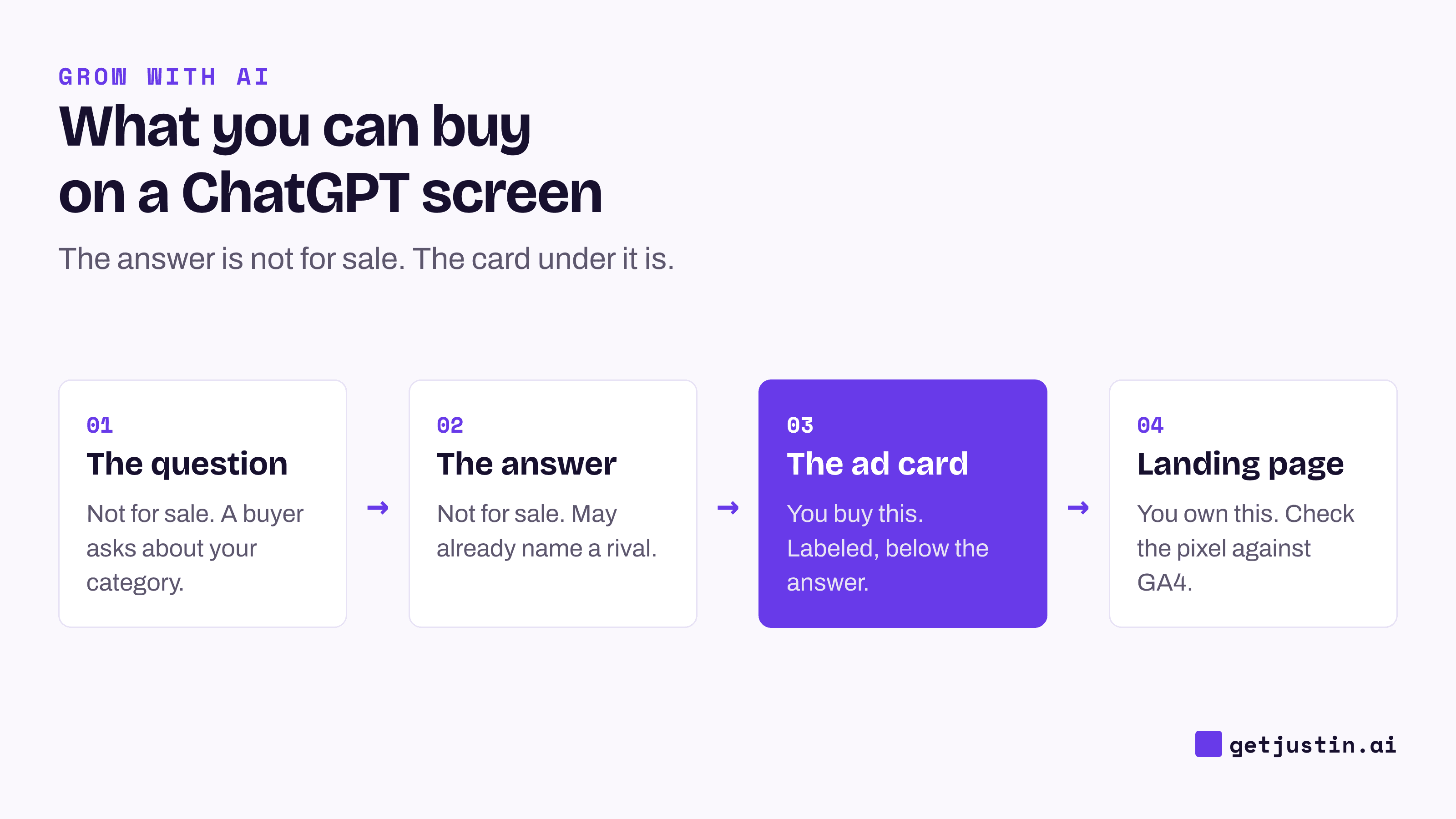
Figure: You buy the space under an answer you don’t control, so research the answer first.
The table sums up ChatGPT advertising as of September 24, 2026.
Question | As of September 2026 |
|---|---|
Who sees ads | Users on the Free and Go plans; not Plus, Pro, Business or Enterprise |
Who never sees ads | |
Where ads run | The US and dozens of other markets, including 31 European markets added in August; confirm your country in Ads Manager |
How to buy | Self-serve Ads Manager, in beta since May 5, 2026, or OpenAI’s sales team and agency partners |
Bidding | Per impression, per click, or per click optimized toward a conversion |
Targeting | Conversation context, country or region, and your own customer lists; no keyword bidding |
Measurement | A tracking pixel and a server-side conversions API |
Topics kept ad-free | Health, mental health and politics during the test; other categories are restricted by market |
Who actually sees ChatGPT ads?
Only the unpaid and low-cost tiers see ChatGPT ads, which cuts out many of the people B2B marketers most want to reach. Anyone using ChatGPT through a company Business or Enterprise plan sees no ads at work, and neither does the person paying for Plus to plan their week. A consumer brand selling to people on free accounts has a much larger share of its buyers in the audience.
What should marketers research before buying ChatGPT ads?
Research five things, in this order, because each can end the test before it costs anything. The checklist below is the version to copy.
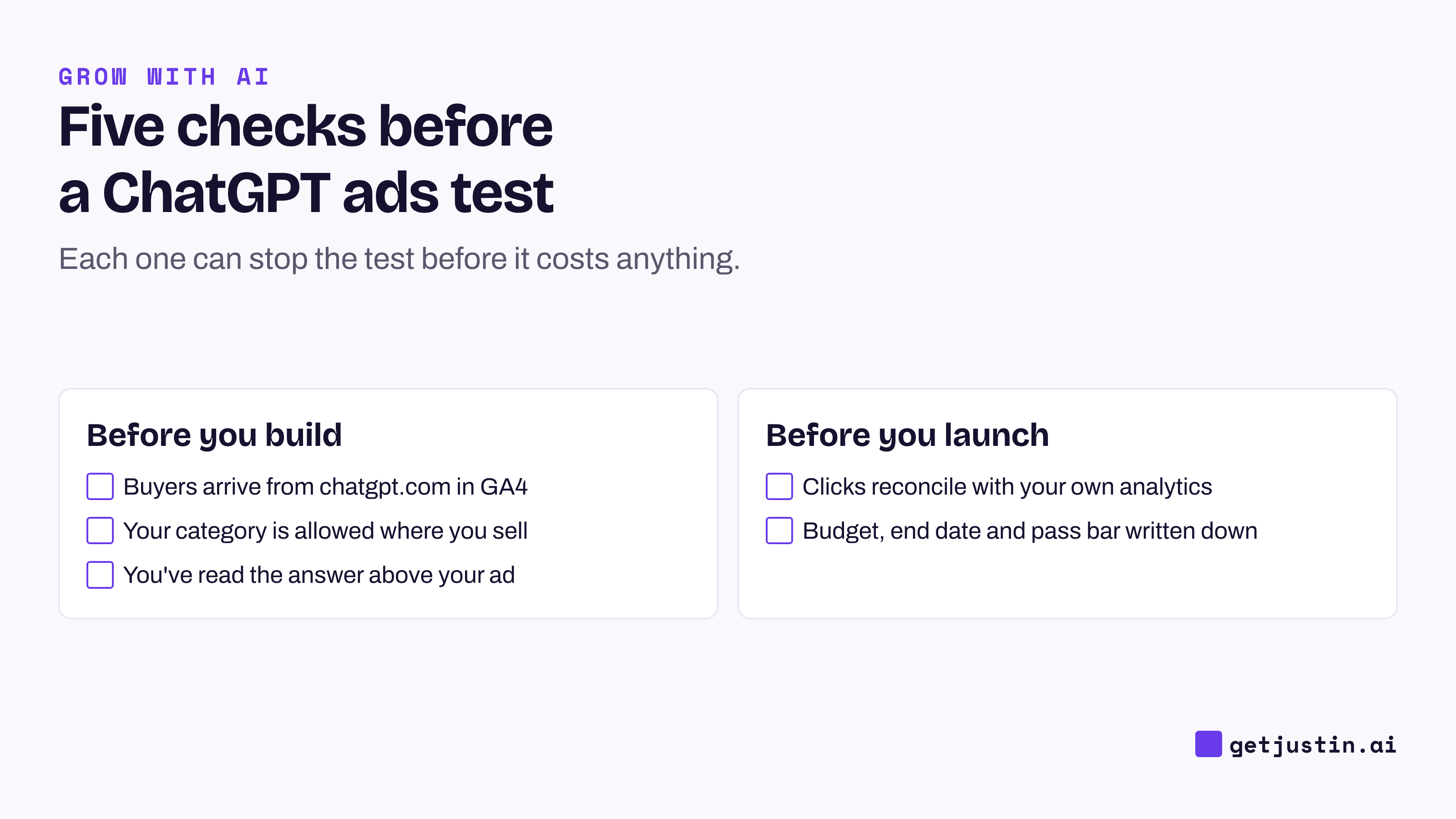
Figure: Each check can stop the test for free; the last one is written before launch.
1. Are your buyers already using ChatGPT? Open GA4 and look for chatgpt.com as a session source over the last 90 days. A few sessions a month says your buyers rarely arrive that way. A steady, growing line says they already ask ChatGPT about your category.
2. Is your category allowed where you sell? Health and financial services face extra rules and vary by country. Dating, gambling, alcohol and political ads are reported as disallowed. Check the current ad policy in Ads Manager before you design anything.
3. What does the answer above your ad say? Ask ChatGPT the 20 questions your buyers ask before they buy, on a free account, and log which brands each answer names. If the answer already recommends a rival, your card sits under that recommendation. That audit is also the starting point for getting your brand mentioned in ChatGPT answers, which costs nothing per click.
4. Can you measure it on a screen you trust? Install the pixel, tag every link, and plan to compare the platform’s clicks with your own analytics every week. One agency that ran a test reported 57 clicks in the ads dashboard and fewer than 20 visits in its analytics. A dashboard agreeing with itself isn’t proof: on our CS team, only a comparison with the client’s own screen caught a reporting error that passed every internal check.
5. What would make you stop, or scale? Write the budget, the duration and the pass bar down before launch, so the team chooses the trade-off deliberately instead of discovering it later. Our CS ops lead did the same before taking on paid promotion for a new product; the brand growth playbook for small teams tells that story.
How to advertise on ChatGPT, step by step
Advertising on ChatGPT follows a familiar self-serve setup once the research says yes. The steps, as described by OpenAI’s launch coverage and one agency’s field guide:
Register as an advertiser in Ads Manager and add payment details.
Choose an objective: reach, clicks, or conversions.
Build an ad group with context hints, a short description of the conversations you want to appear near, instead of keywords.
Write the card: headline, description, image and destination URL.
Install the pixel or connect the conversions API, and make sure OpenAI’s ads crawler, OAI-AdsBot, can reach your landing page.
We haven’t found a public library of ChatGPT ads like Meta’s or Google’s, so the question audit in step 3 is also how you see which rivals are buying. Competitor ad research covers the channels that do publish libraries, and competitor research with AI puts both in the wider plan.
What nobody knows yet about ChatGPT advertising
The honest answer on performance is that it’s too early to say. There are no published benchmarks across advertisers, formats and prices have shifted since launch, and new formats keep arriving: Sponsored Agents, brand-backed chat agents a user can talk to after clicking an ad, launched on September 16, 2026. We’re not sure yet which categories it suits. A small, dated test with a written stop rule beats a big bet on a blog post’s numbers, including this one’s.
FAQ
Do ChatGPT ads influence ChatGPT’s answers?
OpenAI says no: ads run on separate systems, advertisers can’t shape or rank answers, and ads appear in a labeled card below the response. Advertisers see aggregated performance, not conversations. Whether a brand appears inside the answer is a separate question from whether it buys an ad.
How much do ChatGPT ads cost?
OpenAI hasn’t published benchmarks. Self-serve buying has no stated minimum, and an agency guide updated in August 2026 reports recommended starting bids of $3–5 per click. Treat any cost figure as someone else’s test: a starting point for your own small one, re-checked on the day you launch.
Can you target keywords with ChatGPT ads?
No. Ads are matched to the context of the conversation. You describe the conversations you want to appear near, add location, and can upload your own customer lists; you don’t bid on search terms.
Are ChatGPT ads worth it for a small business?
Possibly, if your buyers already reach you from ChatGPT and your category is allowed. Start with the five research checks, then run a small test with a fixed budget, a fixed end date and a pass bar written down first. If your buyers mostly use ChatGPT at work on company plans, they won’t see the ads.
Doing this with Justin
Justin, the AI coworker for Slack, can carry the research and the weekly check in the channel your team already uses. Connect Google Analytics, invite Justin to #growth, then @-mention it and ask how many sessions came from chatgpt.com each week for the last 90 days. Share a file with the 20 buyer questions and the answers you logged, and ask which brands appear most. During a test, ask for an automation that posts every Monday: your analytics sessions next to the clicks from an Ads Manager export you drop in a Google Sheet. Justin uses large language models; its output can be wrong or incomplete — check anything consequential before you act on it.
Related reading
See every ad your competitors are running (and what it tells you)