

Short answer: Agentic AI is AI that works toward a goal in steps: it plans, reads what it needs, uses tools and checks the result, instead of only replying to a prompt. For business teams, the useful kind does the reading and drafting on its own and asks a person before anything that changes a shared system. Autonomy is a setting you widen as trust builds, not the point.
The parts of an AI coworker (model, knowledge, actions and people) are covered in how AI coworkers work. This guide is about the loop agentic AI runs, and where people stay in it.
What is agentic AI?
Agentic AI is a way of using a language model where the AI chooses its own next step toward a goal you set. You say “find out why signups dropped last week”, not “run this report.” The AI works out which reports to pull, reads them, and decides what to check next based on what it found.
Four moves make it agentic: it plans, reads, acts through connected tools, and checks the result before continuing. The quickest test is who picks the next step: a chat tool answers and waits, a copilot suggests and you accept, and an agent picks the next step itself until the goal is met or it needs you. The comparison of AI agents, chatbots and copilots covers all four, and when the steps never change, rule-based automation such as Zapier is cheaper and more predictable.
The example thread below shows the loop in a team channel, including the point where it stops.
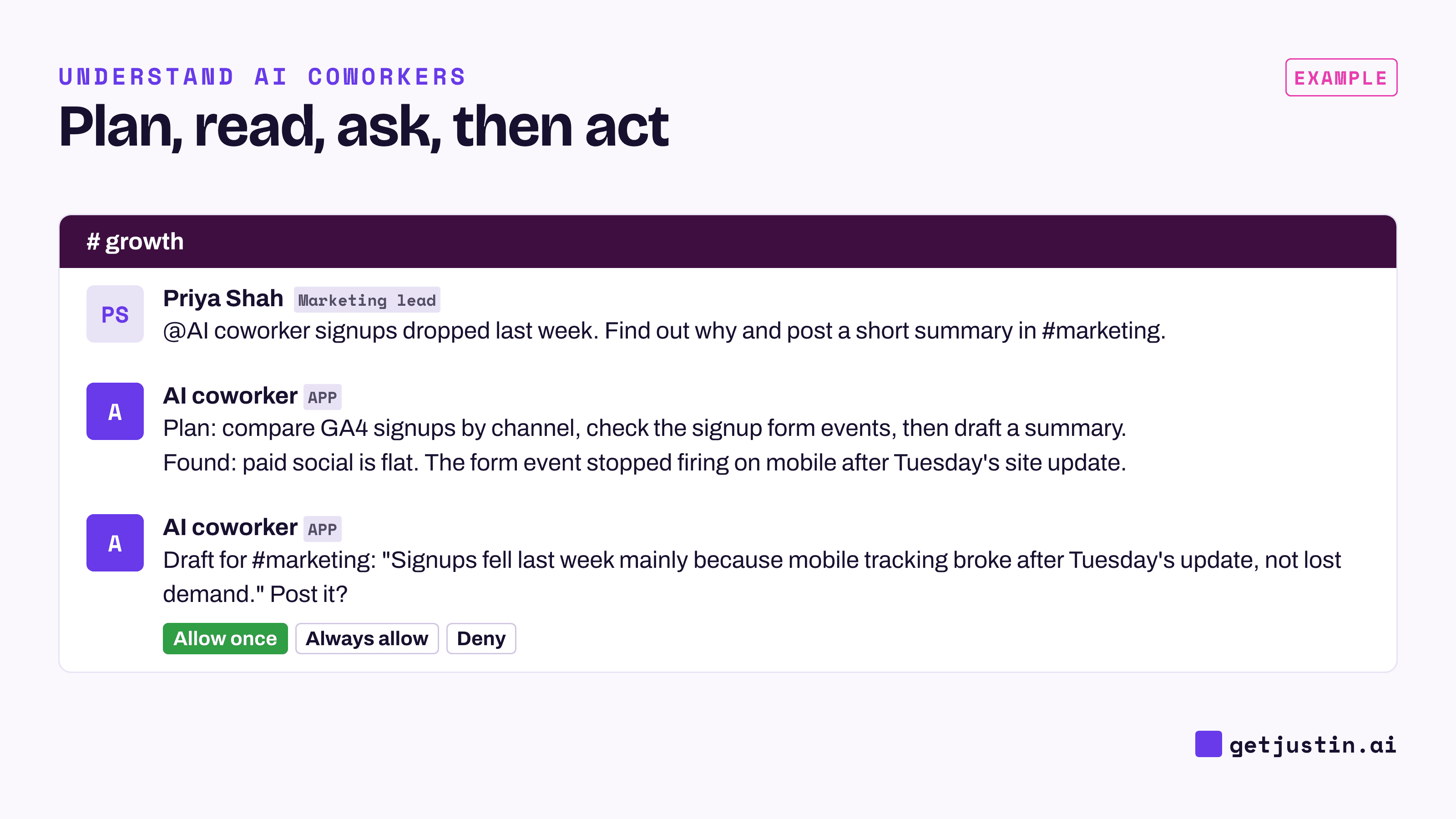
Figure: The AI plans and reads on its own, then stops before it speaks for the team somewhere else.
What does “autonomous” really mean at work?
At work, autonomy is not one switch. It is a separate decision for each kind of action: reading, drafting, replying in the thread where you asked, messaging someone else, and changing a record. Reading and drafting are safe to let run. The last two are where a team sets limits.
A well-built AI coworker lets you widen those limits one kind of action at a time. The first time it wants to post the weekly recap in #leadership, it asks. Once you approve that kind of post from then on, it posts without asking, and the approval stays on record. The ladder below shows the rungs.
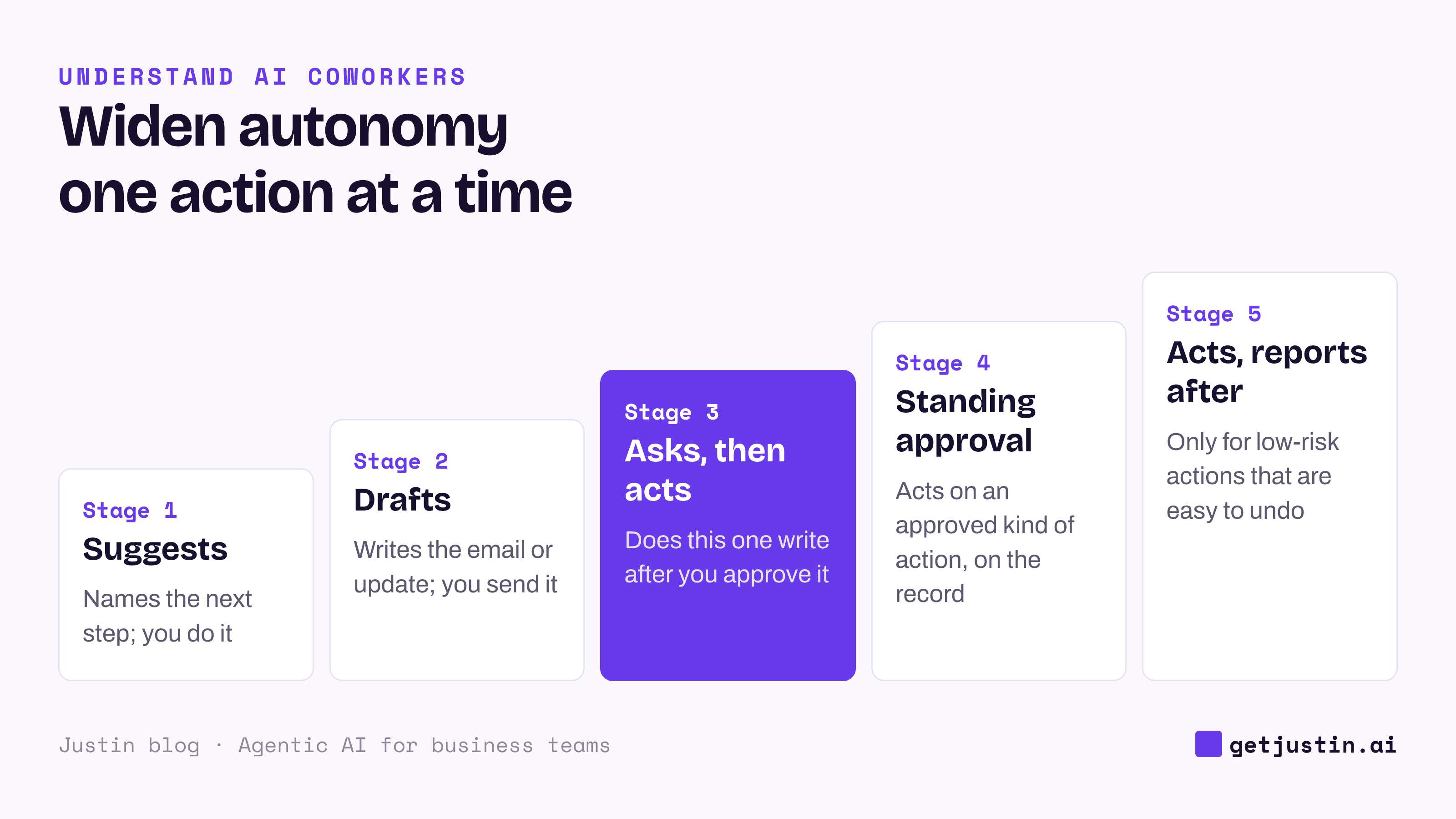
Figure: Teams climb one rung per kind of action, never one rung for the whole AI.
Suggests: it names the next step, and you do it.
Drafts: it writes the email or update, and you send it.
Asks, then acts: it does one write after you approve it.
Standing approval: it acts on a kind of action you approved from then on, and the approval stays on record.
Acts, reports after: only for low-risk actions that are easy to undo.
Our CS ops lead kept autonomy narrow on purpose. When the team designed its AI tool, a fully autonomous version was considered and rejected; its useful parts were kept as on-demand skills and background assists. The AI never asks a client a clarifying question; it asks the CSM. Resolving tickets on its own went into the plan as something to “earn it later.”
Why approvals matter more than autonomy
An agentic system is only as trustworthy as its stopping points. A model that can take ten steps can take ten wrong ones, and people tend to accept what it hands them: 66% of people in a 47-country survey said they rely on AI output without evaluating its accuracy (KPMG and University of Melbourne, 2025). An approval is the moment someone actually checks.
Approvals also cover what the AI can’t know. Our CS ops lead runs a Monday job that drafts two leadership updates from a personal daily work log. The log runs a day behind and often says “preview only”, so the job may never mark anything as shipped; those items go under “Confirm before pasting.” That caught a real miss: a feature logged as preview on Sunday was live by the Monday readout, which only the ops lead knew.
Where the AI’s judgment isn’t calibrated yet, take the judgment out. A daily scan once labeled a struggling account “Healthy” because its thread was about setting up a weekly sync; the declined meetings behind that sync were the real warning. The ops lead added calibration rules first, then removed risk labels altogether. The notes are now dated facts, and verdicts wait for a person.
One more rule, told in full in the four-layer guide: approving a plan is not approving the write. Ask for each write as its own decision.
Agentic AI examples for business teams
Agentic AI examples at work share one shape: a goal in plain words, steps the AI takes alone, and one clear place it stops.
Team | Goal you give it | What it does on its own | Where it stops and asks |
|---|---|---|---|
Marketing | “Find out why signups dropped last week” | Compares GA4 traffic by channel, checks for a tracking gap, drafts a summary | Before posting the summary in #leadership |
Sales | “Prep me for Thursday’s renewal call” | Reads the CRM record, recent emails and open tickets; drafts a one-page brief | Before logging anything to the CRM |
Support | “Which tickets this week mention the new pricing?” | Searches the help desk, groups tickets by issue, drafts a reply template | Before replying to any customer |
Finance | “Chase the invoices that are 30 days overdue” | Matches billing records to the customer list, drafts reminder emails | Before any email goes out |
Customer success | “Update the account notes from this week’s threads” | Reads client channels, lists dated facts per account | Before writing to the shared notes |
Start with a goal you check yourself every week, so you know the right answer. Read the plan, approve each write for the first few weeks, and widen one kind of action only once approving it has become a formality.
FAQ
Is agentic AI the same as an AI agent?
Nearly. Agentic AI describes the behavior: planning and taking steps toward a goal. An AI agent is software that behaves that way, and an AI coworker is an agent a whole team shares, with memory and approvals.
How much autonomy should agentic AI have at work?
Less than the word suggests, and set per kind of action rather than for the whole AI. Let it read and draft freely, and have it ask before it messages anyone else or changes a record. Widen one kind of action at a time, once approving it has become a formality.
Do you need to code to use agentic AI?
No. With an AI coworker in your chat tool, you describe the goal in plain words, and someone on the team authorizes the tools it may use. Engineers are needed only to connect internal systems that have no ready-made connector.
What can go wrong with agentic AI at work?
The common failures are quiet: a step built on a wrong assumption, a missing fact presented as complete, or a write nobody clearly approved. Keep irreversible actions behind an approval, test the AI on work you know well, and prefer dated facts over verdicts until its judgment has earned trust.
Doing this with Justin
Justin, the AI coworker for Slack, works toward a goal in the thread where you ask. Give it a goal in plain language in a channel or a DM; it reads the thread, reaches into connected tools and posts the result back, with a status line while it works. Reading doesn’t need approval. It asks in the channel before it writes to your connected tools: you can approve just that action, or that kind of action from then on, and every approval is recorded with who gave it and when. If nobody answers straight away, the approval card in the thread still works later and the job resumes where it paused. Start with one goal you already check every week.
Related reading
How AI coworkers work: the model, what it knows, what it can do, and who’s in charge
An AI usage policy for agents that take action (template)