

Short answer: Don’t ask your team for AI ideas. Ask which task each person repeats every week, how long it takes and what goes wrong, then turn the best two or three into shared skills that same week. A two-week sprint in one Slack thread, a simple score of frequency, time and risk, and the submitter as the skill’s owner is all the process a small team needs.
Most attempts to crowdsource AI use cases from your team start with “send us your AI ideas” and end in a spreadsheet nobody acts on. The fix is a different question and a faster loop, with no steering group in between.
Why “send us your AI ideas” gets you nothing useful
Asking for AI ideas makes people imagine what AI could do, which is hard for anyone who doesn’t use it daily. You get silence, or big ideas nobody can build (“an AI that plans our quarter”). Some people also keep quiet about how they already use AI: 48% of desk workers said they’d be uncomfortable admitting AI use to their manager (Slack Workforce Index, 2024).
Everyone can answer a question about their own week. So ask about the work, and leave the AI part to whoever builds the skill.
Instead of asking | Ask |
|---|---|
“What could AI do for you?” | “What do you do every week that follows the same steps?” |
“Any AI ideas?” | “What took you longest last week that you’ve done before?” |
“Which tools should we automate?” | “What do you copy from one place into another?” |
“What’s your AI use case?” | “What goes wrong when you’re rushed?” |
How do you crowdsource AI use cases from your team in two weeks?
Run a two-week sprint with one post, a few short follow-ups and a build week. The diagram below shows the days.
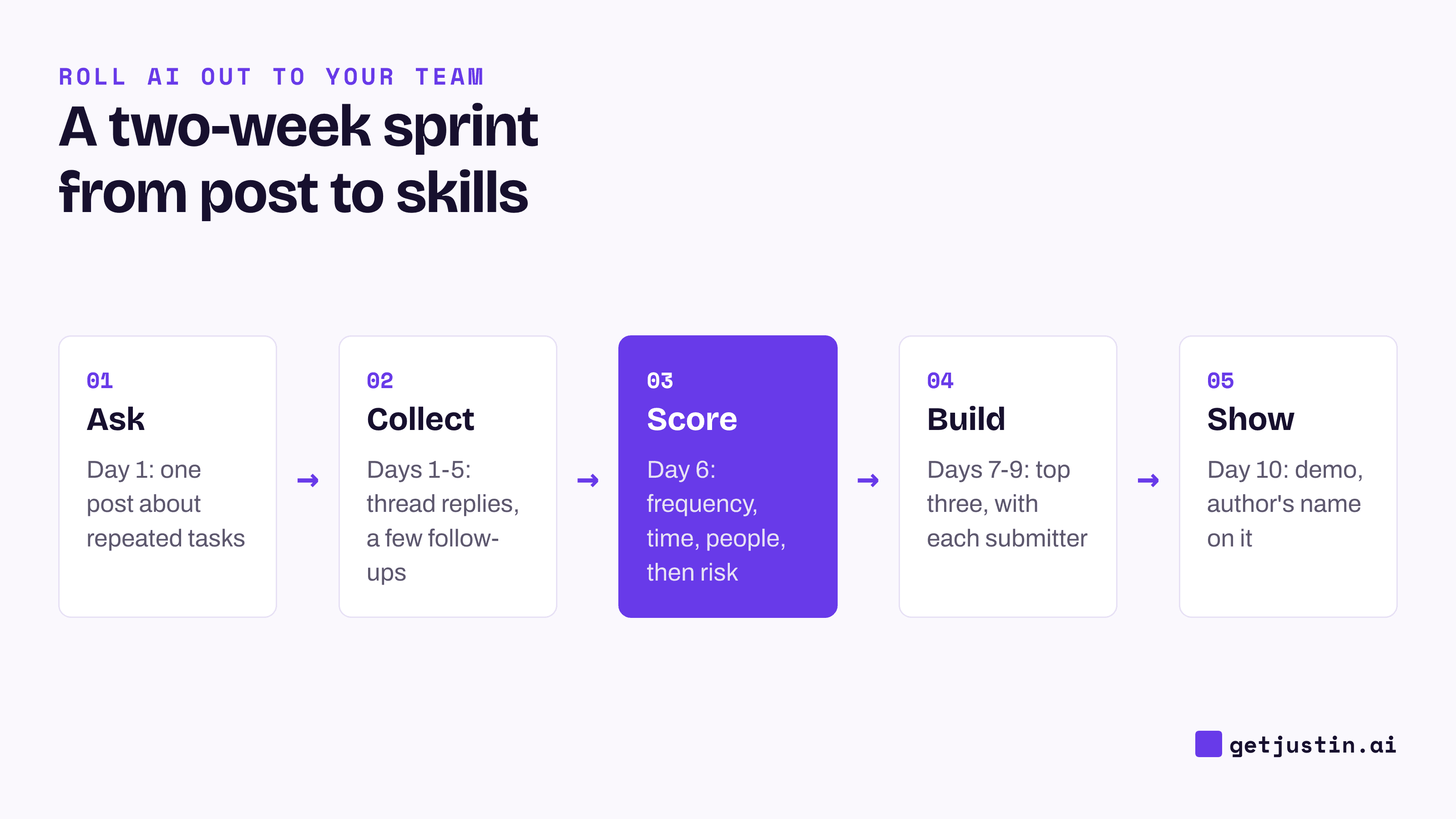
Figure: Two weeks from one Slack post to two or three working skills, each with its author’s name on it.
Day | What happens | Who | Time |
|---|---|---|---|
1 | Post the question in the team channel | Team lead | 5 minutes |
1–5 | Replies come in the thread; follow up with three or four people for 15 minutes each | Whoever builds skills | About 1 hour |
6 | Score every reply and pick two or three | Team lead and builder | 30 minutes |
7–9 | Build each winner with the person who named it | Builder and submitter | Half a day each |
10 | Show the skills in the team meeting, with names on them | Each submitter | 5 minutes each |
Here is a post you can copy:
Quick one for everyone: what’s one task you do every week that follows roughly the same steps? Reply in this thread with the task, about how long it takes, and what goes wrong when it’s rushed. You don’t need to know anything about AI, and “it’s boring” is the best qualification. We’ll turn the top three into shared skills by Friday next week, with your name on each one.
Keep the intake a reply in a thread, not a form, because a reply is the cheapest thing to give. We learned the same lesson building an approval flow, a story told in the AI agent usage policy template.
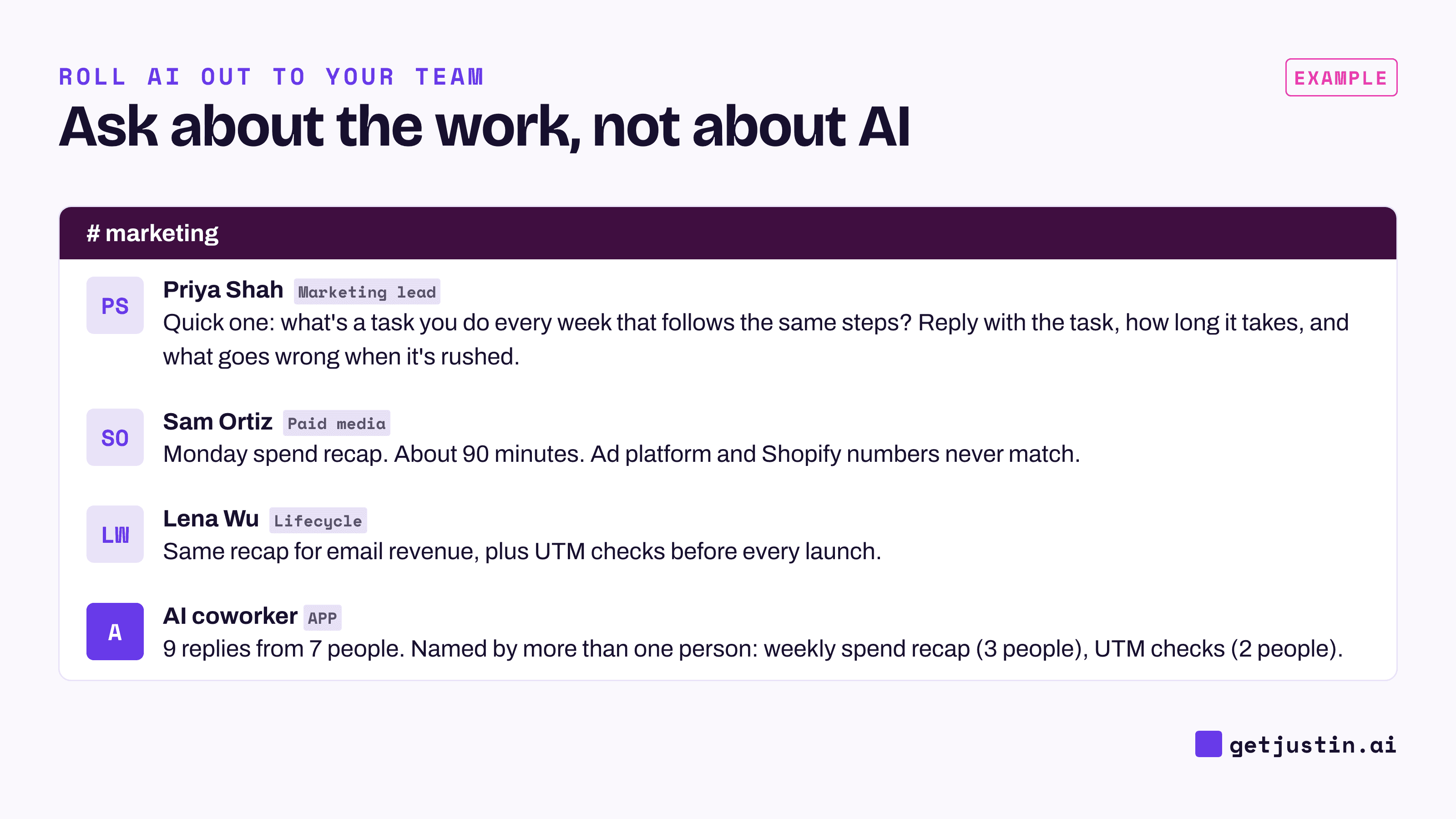
Figure: The replies already contain what the score needs: the task, how often, how long and what goes wrong.
Pick winners by frequency, time and risk
Score each task by how often it happens, how long it takes and how many people do it, then use risk to set the order. Multiply the first three into hours a month. Treat risk as a gate, not a number: anything that sends to customers or changes a live system waits, or runs behind an approval.
Task | Times a month | Minutes each | People | Hours a month | Risk | Pick? |
|---|---|---|---|---|---|---|
Example: weekly spend recap | 4 | 90 | 3 | 18 | Low: stays internal | Yes |
Example: UTM check before a launch | 8 | 20 | 2 | 5.3 | Low: read-only | Yes |
Example: quarterly board deck | 0.33 | 480 | 1 | 2.7 | Medium | No: too rare |
Example: replies to public reviews | 30 | 5 | 1 | 2.5 | High: public | Later, with approval |
Count people, not mentions. When we ranked 1,351 client questions for a study, we ranked them by how many distinct companies asked, never by raw counts, “or one chatty account manufactures a theme.” A task one enthusiastic person mentions five times is still one person’s task. A task two people name separately is a pattern: “Once is a fluke, twice is a pattern.”
Build the winners that week, with the person who named them
Build each winning task within days, with its submitter in the room. Speed is the reward for replying; a shortlist that sits for a month teaches the team not to answer next time.
The submitter is the expert, so the build starts with a short interview: their last good example, where each number comes from, and what they check before sending. The intake interview in the skills library playbook has the five questions, and the guide to writing your first skill covers the brief itself. Test the draft on the submitter’s own work from last week.
When the submitter looks confused by the output, write that down. A note from one of our own test plans: “treat the CSM’s confusion as the finding.” Confusion usually means the skill guessed at something the submitter knows.
Credit the author, and make them the owner
Put the submitter’s name on the skill, say so in the channel, and make them its owner. Credit makes AI use visible in a team where some people would rather hide it, and ownership keeps new work from routing through one person; the AI champions program tells how that happened on our team.
Ownership is small in practice: the owner checks the output, fixes the skill when their process changes, and picks keep, change or retire on its review date. The builder helps; the owner decides.
Keep it going monthly
Repeat the same question on the first Monday of each month, and give one owner five minutes in the team meeting to show their skill working. What stays fixed is the absence of a committee: one post, one score, one owner per skill. As the team grows, a champion usually runs the monthly slot.
FAQ
How do you collect AI use cases from employees?
Ask about their work, not about AI: which task they repeat every week, how long it takes and what goes wrong when it’s rushed. Collect the answers as replies in one thread, follow up with a few people for 15 minutes each, and score the tasks by frequency, time and number of people.
What should an AI idea intake ask?
Three things: the task, roughly how long it takes, and what goes wrong when it’s rushed. Leave out questions about tools, AI or business value; the builder works those out. The shorter the intake, the more people reply.
Do you need an AI committee to choose use cases?
Not in a team under 200 people. A team lead and whoever builds skills can score replies in half an hour, and risk works as a gate rather than a debate: anything that sends externally or changes a live system waits for approval.
How many AI use cases should a small team start with?
Two or three per sprint. Build them the same week, with the person who suggested each one, and run them for a month before starting another round.
Doing this with Justin
Justin, the AI coworker for Slack, can do the tally. Invite it to the team channel and post your question. When replies are in, @-mention Justin in the thread and ask it to group the replies by task and count how many different people named each one; it can read the whole thread when you ask. Ask for the shortlist as a live page, and change it by asking in the channel, so the link stays the same. To repeat the sprint, ask for an automation, such as posting the question to #marketing on the first Monday of each month, and ask Justin to read the terms back before it starts. Check its counts against the thread before you pick winners, since its output can be wrong.
Related reading
From prompt library to skills library: collect your team’s best workflows
AI agent skills for non-technical teams, and how to write your first one
How AI coworkers work: the model, what it knows, what it can do, and who’s in charge