
Short answer: An AI champions program gives one trusted person per team a few protected hours a week to turn the team’s repeated work into one shared way of using AI, and to help colleagues adopt it. For a company of 20 to 200, start with one champion for each team that shares a weekly job, two protected hours a week and a 15-minute show-and-tell once a month, then review after a quarter.
Most AI champions program guides assume thousands of employees and a center of excellence. A small company’s problem is different: whoever set up the AI coworker quietly becomes everyone’s help desk.
Why does a small company need AI champions at all?
A small company needs AI champions because otherwise every AI question routes to whoever set the tool up. On our CS team that was our CS ops lead: in one two-week stretch, eight colleagues across data science and CS routed their AI requests through that one person. The plan the ops lead then wrote for leadership carried one hard rule: any plan that routes new AI work through its author fails, so every item names a different owner.
People also won’t ask the boss. Nearly half of desk workers (48%) told Slack they’d feel uncomfortable telling their manager they use AI on routine work, mostly for fear of looking lazy or like cheaters (Slack Workforce Index, 2024). And BCG found regular use was sharply higher among employees with at least five hours of training plus in-person coaching (BCG AI at Work, 2025). A champion is that coaching, from a peer, sized for a small team.
What does an AI champion do, and what don’t they do?
The AI champion role is mainly about consistency: each recurring job gets done one agreed way, not five personal ways. On our CS team, the gap that mattered wasn’t knowledge but the same client question answered differently depending on who was in the room; the skills library playbook has the numbers.
The champion runs the process, but the people doing the work write the workflows; our CS ops lead’s shorthand is “orchestration is not authorship.” Power users are the source of the best examples, and the ops lead’s note on them was “build them nothing.” Newer colleagues are the real target, and they need one standard path per job.
An AI champion does | An AI champion doesn’t |
|---|---|
Finds the jobs the team repeats weekly | Collect “AI ideas” in a sheet nobody reads |
Gets one way written per job, with a real example | Build a personal version for each colleague |
Answers in the team channel, where others see it | Run a private help desk in DMs |
Reports missing permissions to the tool’s owner | Grant access or approve writes for others |
Shows one real result a month | Own the AI policy or the tool budget |
How many AI champions do you need, and who should they be?
You need one AI champion for each team that shares a recurring job, not one per fixed headcount. The ratios repeated across champion guides (one per 15 to 20 employees, one per 50 to 75) cite no study we could find, and they were written for companies of thousands. A champion who doesn’t do the job can’t write down how it’s done.
Example sizing, to adjust to how your teams split:
Company size | Teams sharing a weekly job | Champions | Coordination |
|---|---|---|---|
20 | 2 (e.g. marketing, sales) | 1–2 | None; they talk monthly |
50 | 3–4 | 3–4 | One champion doubles as coordinator |
100 | 5–7 | 5–7 | A coordinator, about an hour a week |
200 | 8–12 | 8–12 | A coordinator inside an ops role |
Pick the person colleagues already ask “how do I…”, even if they aren’t the heaviest AI user. AI fluency takes weeks to teach; trust can’t be assigned. Don’t default to the manager, for the reason in the Slack figure above. And don’t default to your power user: their examples are worth more than their evenings.
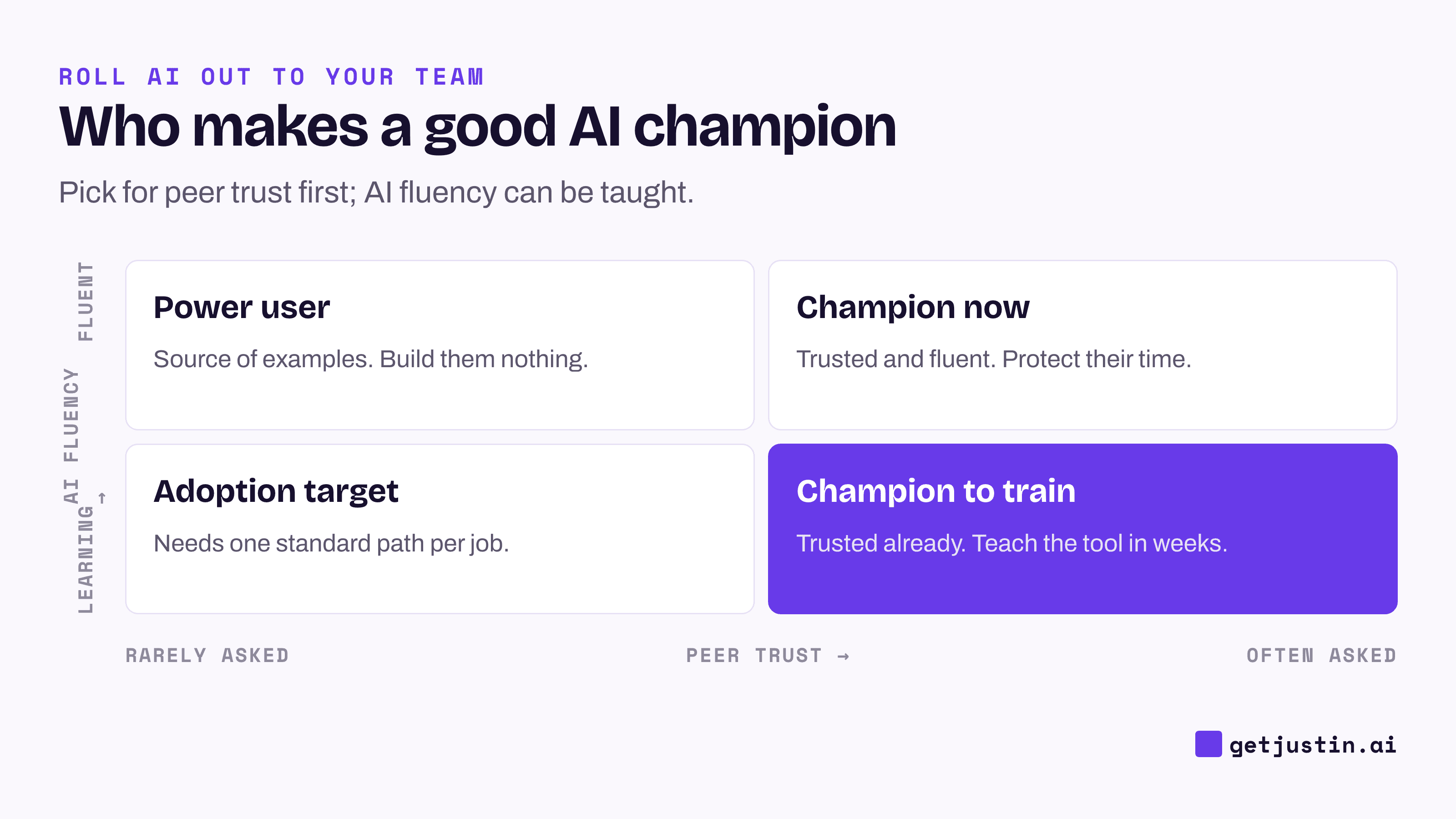
Figure: Pick for peer trust first; you can teach AI fluency, but you can’t assign trust.
How much time and which rituals should AI champions get?
Two protected hours a week, written into the champion’s goals by their manager, is enough for a small team. Below an hour, the role shrinks into answering DMs between meetings; past half a day, it needs its own title.
30 minutes of office hours in the team channel, same slot every week.
60 minutes writing down one repeated job, with a real finished example. The guide to writing your first skill covers what goes in it.
30 minutes checking last week’s workflow: did anyone besides its author use it, and what broke?
Keep the monthly ritual short and built on real work. For our own team, the ops lead recommended a five-minute live demo in an existing team sync plus a wiki page, adding tips only if the first one lands. Each tip comes from one of the ops lead’s real sessions, so it reads as “this is how it’s used here,” not theory. The cycle below shows a champion’s month: office hours surface a repeated question, the champion writes one path for it, shows it at the show-and-tell, checks whether anyone else reused it, then keeps, fixes or retires it before picking the next job.
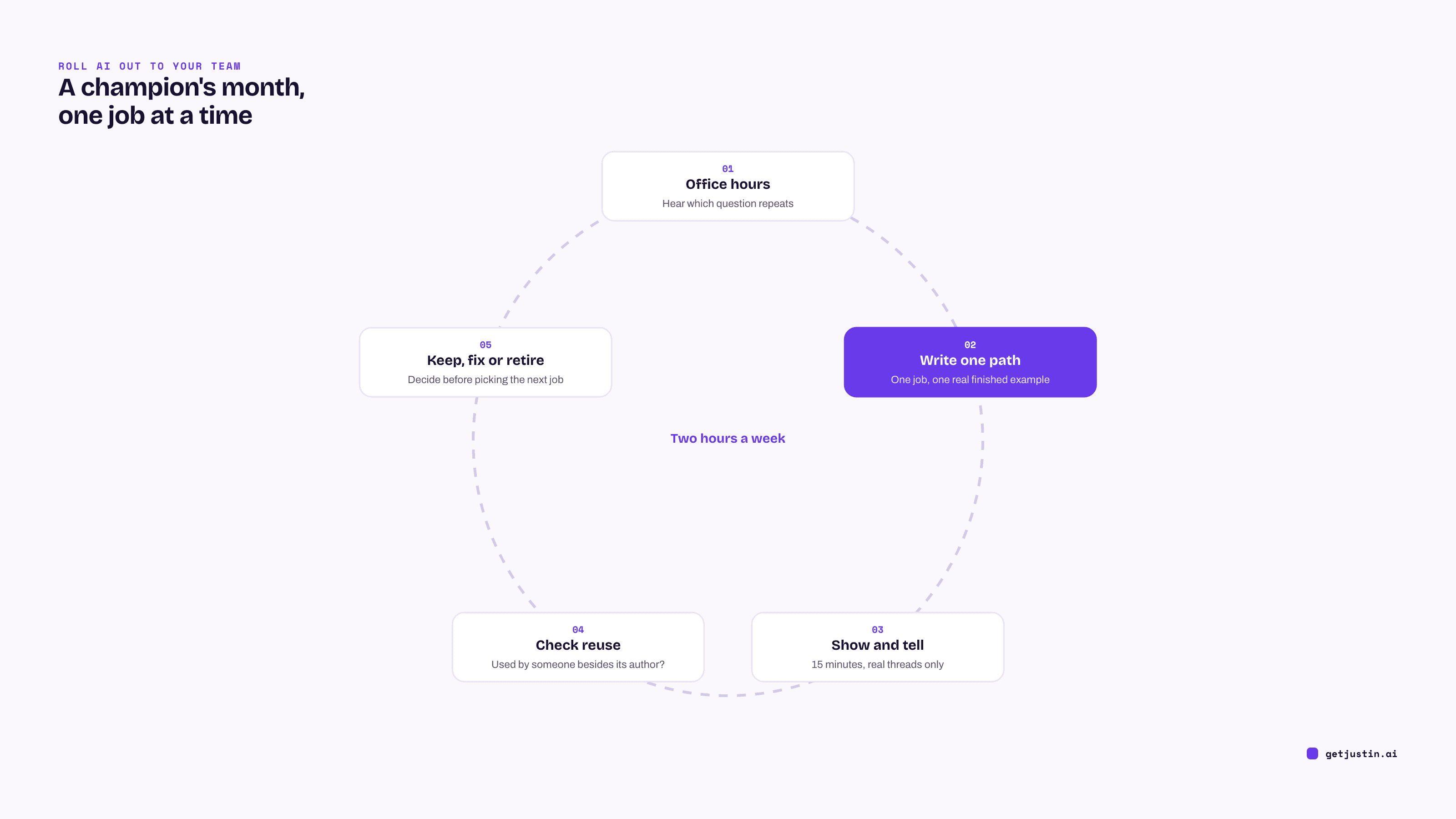
Figure: A champion’s month moves one job from a repeated question to a shared, checked workflow.
Minutes | Show-and-tell agenda | Rule |
|---|---|---|
0–2 | Name last month’s workflows and their authors | Names, not counts |
2–10 | Two colleagues each show one real thread | No demos built for the meeting |
10–13 | One thing that went wrong, and the fix | Required every month |
13–15 | Pick next month’s job to write down | From office-hours questions |
Credit the author, not the champion: their name goes on the workflow and gets said out loud, the same way you’d crowdsource AI use cases.
How do you measure an AI champions program?
Measure an AI champions program by work handed over, not attendance. Three counts you can take by hand from the channel each month:
Workflows with a named author and a real example.
Workflows used by someone other than their author in the last 30 days.
Repeat questions: the same “how do I” twice means the written path is missing or unclear.
We haven’t solved measurement on our own team, so count what’s visible and treat it as a floor. The AI adoption scorecard has a fuller set, and the reason our tracking fell short.
The AI champion charter to copy
Paste this into your team doc and review it at the end of the quarter: keep, change or stop.
Field | Example |
|---|---|
Champion and team | Example: Priya, growth marketing |
Jobs in scope (three at most) | Weekly performance recap; campaign QA |
Protected time and slot | 2 hours a week; office hours Tuesday 11:00 |
Manager sponsor | Head of marketing, who protects the time |
Tool owner | Ops lead: access, permissions, broken connectors |
Out of scope | Approving writes, policy, buying tools |
Show-and-tell | First Thursday of the month, 15 minutes |
Review date | Last week of the quarter |
FAQ
What is the difference between an AI champion and an AI ambassador?
They are usually the same role under two names. AI ambassador programs tend to lean toward promotion and training sessions; champion programs lean toward doing the work alongside the team. Whatever you call it, write down what the role does and doesn’t do.
How many hours a week should an AI champion spend?
About two protected hours a week works for a team of 8 to 12. Put the hours in the champion’s goals with their manager’s sign-off, and if they slip three weeks running, narrow the jobs in scope.
Should AI champions be paid extra?
Protected time and visible credit matter more than pay. What burns champions out is unpaid time on top of a full job, so protect the two hours first and name the role in their review.
Can a manager be an AI champion?
A manager can sponsor the program but makes a weaker champion, because people hesitate to show a manager how they use AI. Choose a peer the team already asks for help, and have the manager protect that person’s time.
Doing this with Justin
Justin, the AI coworker for Slack, suits a champion who works in public. Invite it to the team channel and @-mention it; it replies in a thread, so each answer stays visible to the next person who needs it. It works from shared team memory, so when the champion asks it to remember a correction, it keeps it for the team. There are no seats: every plan covers the whole team with pooled credits, so nobody rations logins. For the monthly ritual, ask in one sentence for an automation, such as a show-and-tell reminder in #marketing on the first Thursday of each month, and ask Justin to read the terms back before it starts.