
Short answer: The best Claude Tag alternatives depend on why it doesn’t fit. If you aren’t on Claude Team or Enterprise, need a stop before each action, or have people on Microsoft Teams, look at Viktor, Dash, Junior or Justin; if you want Slack’s own AI or a self-hosted agent, look at Slackbot or an open-source build. If you already pay for Claude Team and your channels mostly need a strong model, keep Claude Tag.
Claude Tag is in beta, so recheck before you buy.
What Claude Tag does well
Claude Tag is Anthropic’s shared Claude for Slack: anyone in a channel can tag it, and it works on the thread in front of it. It launched in beta on June 23, 2026 for Claude Enterprise and Team customers, according to Anthropic’s launch post.
The post lists real strengths. The launch post says it runs on Claude Opus 4.8, though as of September 24, 2026 Claude’s pricing page lists Opus 5.5, so confirm the model on Anthropic’s pricing page before you buy. It can schedule its own tasks to pursue a project over days. Admins see a log of every task and who asked, and set token spend limits per organization and per channel. Per Anthropic’s docs, as of September 2026, what it learns in public channels is shared across the workspace, while private channels keep their own.
If you already pay for Claude Team, there’s no new vendor to review. In engineering channels, where a thread turns into code, a model this strong is hard to beat.
Why teams look for Claude Tag alternatives
Most teams leave for one of five reasons, each pointing to a different alternative.
Reason you’re looking | What Claude Tag offers, as of Sept 2026 | Where to look |
|---|---|---|
You aren’t on Claude Team or Enterprise | Available only on those plans (Anthropic) | Justin, Viktor, Dash, Junior, Runbear, Slackbot |
You want a stop before each action | Admin scoping, spend limits and an activity log; no per-action approval step is described | Justin, Dash, Viktor, Junior |
Part of the company uses Microsoft Teams | Slack only for now, with wider availability planned | Viktor, Dash, Junior, Runbear |
You want a different model, or to self-host | Anthropic’s models, hosted by Anthropic | Open Claude Tag, Viktor |
You want a flat price for the team | Plan seats plus token usage, with no published usage rate | Justin, Viktor, Dash |
The plan requirement is the one that surprises people. Claude Team standard seats cost $20 a month billed annually, or $25 monthly, for teams of 2 to 150, and Enterprise is a seat price plus usage at API rates (Claude pricing). Example: if all 12 people on a team take Team seats, that’s $240 a month before any agent usage.
For teams whose agent touches client accounts, the approval gap matters more than price. Scoping decides which tools the agent can reach; it doesn’t make it stop and show you the exact change first.
The Claude Tag alternatives, and where each one wins
Each option wins somewhere Claude Tag doesn’t. Prices are as published in September 2026.
Slackbot. Slack’s built-in personal AI agent, included in Business+ at $15 per user a month billed yearly (Slack). It wins on search and recaps with no new vendor, but it’s built around one person.
Viktor. A Slack-native AI coworker priced per workspace from $50 a month on credits (Viktor). It works in Slack and Microsoft Teams, lists SOC 2, and says you approve sensitive actions before they run and can use any model (Viktor). Watch Viktor’s credits on your heaviest job.
Dash (Process Street). $50 a month for 20,000 credits shared by the whole team, with no seats, and $100 in free credits for new workspaces (Dash pricing). By Dash’s own description, writes pause for approval by default; it runs in Slack, Microsoft Teams and the web, and lists SOC 2 Type II and ISO/IEC 27001 (Dash). It wins if a security review needs certifications today.
Junior. Works in Slack or Microsoft Teams and describes itself as asking before it acts (Junior). It is credit-based from $100 a month and runs on Claude models (Junior pricing), so it suits teams that want Claude without Claude seats.
Runbear. A Slack-native agent platform, also on Microsoft Teams, built around a roster of named agents such as @HR or @SalesOps, each with its own role and owner, that reason over standing org knowledge like rosters, policies and documents. Its agents act through the asker’s own connected accounts and permissions, and it prices by usage rather than per seat (Runbear). It suits a company that wants several department agents instead of one shared Claude.
Open Claude Tag. An MIT-licensed, self-hosted project that runs any model through LiteLLM and keeps data on your own servers (GitHub). It wins on control if an engineer will run it, but it’s early: ambient mode and governance are future phases.
Zapier or n8n. The better answer when the job runs the same way every time; see AI agents vs Zapier and n8n.
Justin (ours). An AI coworker for Slack, with a web app for setup and live pages, from $20 a month with no seats (Justin). It asks before it writes to your connected tools; approve once, or for that kind of action. It keeps a shared team memory of what your team tells it. It is in early access and doesn’t support Microsoft Teams.
The diagram below lines up the channel coworkers on the questions that decide most switches.
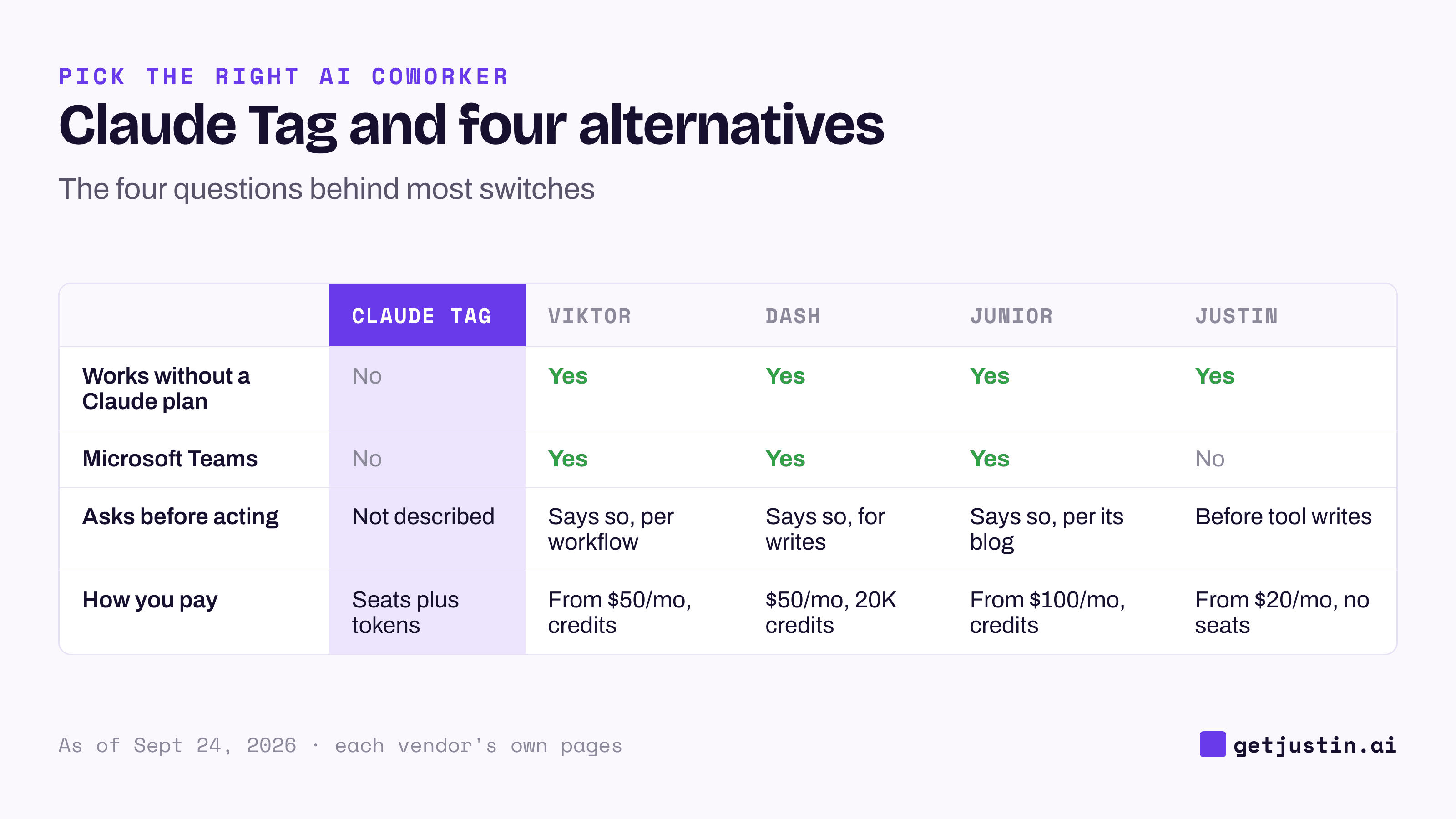
Figure: The switch usually comes down to the plan you need, Microsoft Teams, a stop before actions, and how you pay.
Two trial tests for the gaps Claude Tag leaves
Run your trial on the gap you’re leaving over. Of the five general trial tests for Slack agents, these two matter most for Claude Tag.
1. The identity test: whose name is on the message? A shared agent posts as itself, which suits some messages and not others. At WorkMagic, our CS ops lead picks the identity job by job with a bot-or-own-name rule, and no message reaches a client from the AI, because the CSM owns every external send. In your trial, ask the agent to follow up with a customer; a pass is a draft that shows the recipient and exact text, then waits.
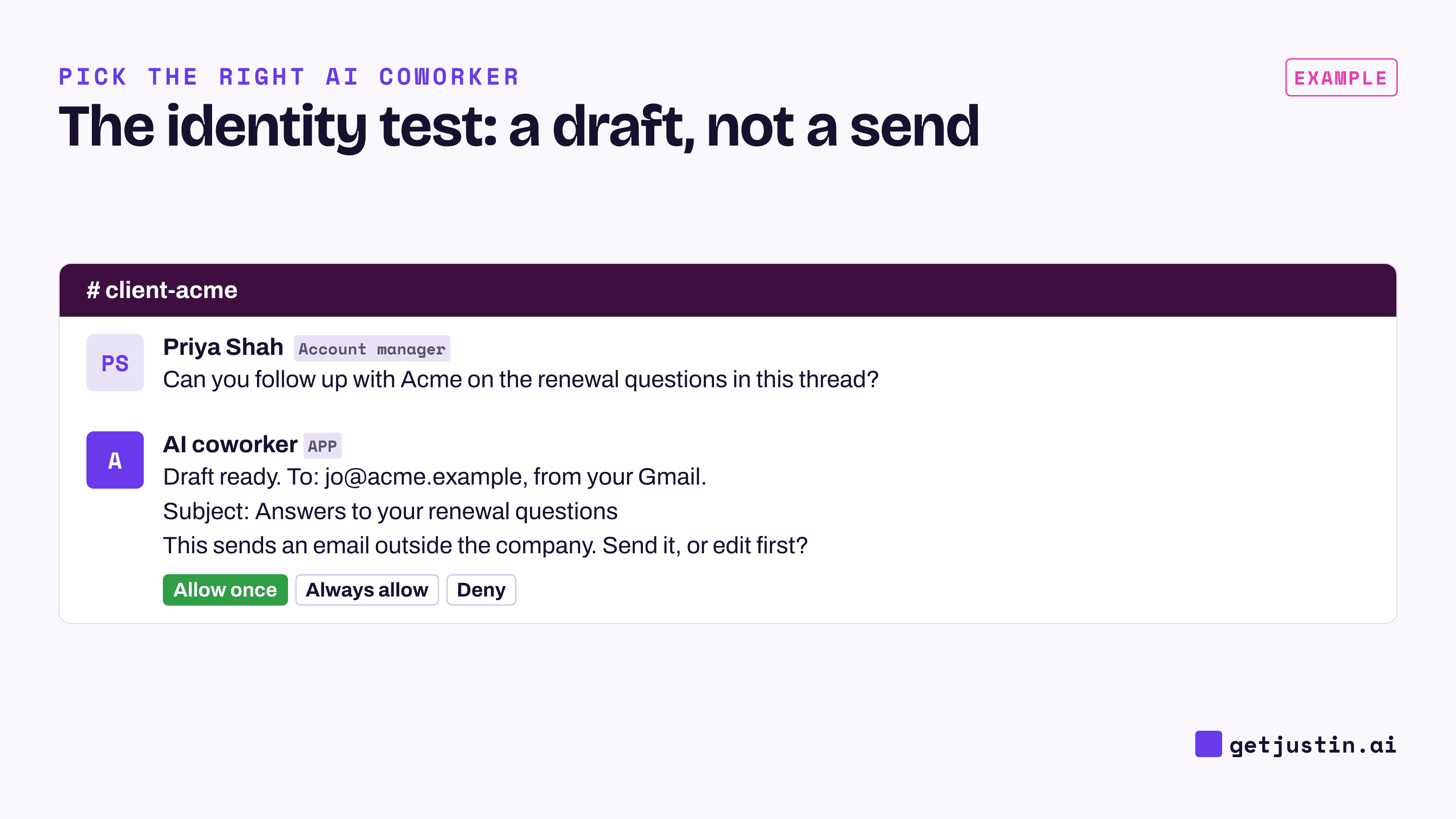
Figure: A pass on the identity test: the agent drafts the send, names the recipient, and waits.
2. The ambient test: what does it say on its own? Claude Tag’s ambient mode posts updates it thinks you need, and those are only as good as the record they read. The ops lead’s Monday job drafts leadership updates from a work log that runs a day behind, so it may never mark anything shipped. The miss was real: a feature logged “preview only” on Sunday was live by Monday.
Leave any proactive agent in a busy channel for a week and check each unprompted update against what you know. The ops lead’s rule: “The machine is good at surfacing the candidate. It has not earned the irreversible call.”
How to choose: stay, switch or run both
Stay on Claude Tag if you already pay for Claude Team or Enterprise, your channels are mostly engineering work, and admin scoping plus the activity log pass your review.
Choose Viktor, Dash or Junior if part of the company is on Microsoft Teams.
Choose Runbear if you want several named department agents that act with each asker’s own permissions.
Choose Open Claude Tag if you need to self-host or pick your own model, and have an engineer to run it.
Choose Slackbot if each person mostly needs search and summaries and you’re on Business+.
Choose Justin if a small team wants a coworker that asks before it writes to your connected tools, shared team memory, and a flat team price without Claude seats.
Running both can work: engineers keep Claude Tag, and another AI coworker handles client work where every write needs a yes.
FAQ
Is Claude Tag included in Claude Team?
Yes. As of September 2026, Claude Tag comes with both Claude Team and Enterprise as a beta, and Claude’s pricing page lists @Claude on both. Anthropic describes token spend limits but publishes no separate usage rate, so watch your first month’s bill.
Does Claude Tag ask for approval before it acts?
Anthropic’s launch post describes admin controls: tool and data scoping per channel, spend limits and a log of every task. It doesn’t describe the agent showing a specific change and waiting for a yes. If you need that, test it in your trial or pick an alternative that asks before it acts.
Is there a Claude in Slack alternative that works in Microsoft Teams?
Viktor, Dash, Junior and Runbear all list Microsoft Teams alongside Slack as of September 2026. Claude Tag is Slack only for now, though Anthropic plans to expand. Justin works in Slack, with a web app for setup and live pages, and doesn’t support Microsoft Teams.
Claude Tag vs Slackbot: which should a small team use?
Slackbot comes with Slack Business+ and suits one person’s search and recaps. Claude Tag is a shared agent the channel can hand work to, but it needs a Claude Team or Enterprise plan. If you have neither, price both against a flat-priced alternative before buying seats.
Doing this with Justin
Justin, the AI coworker for Slack, is one of the alternatives above, so run both tests on it. The free trial covers the whole team for 14 days or 1,000 credits, whichever comes first. Invite Justin to a client channel and @-mention it. For the identity test, ask it to follow up with a customer and check what you see before anything goes out. Then ask it to update a record in a connected tool: it asks before it writes, and you can approve once or for that kind of action. Ask for a summary of the account as a live page; it shows when its data was last updated, and you can ask where any number came from. Justin uses large language models, so check anything consequential before you act on it.